

Legal Legends of Color Award: Charles Edison Smith
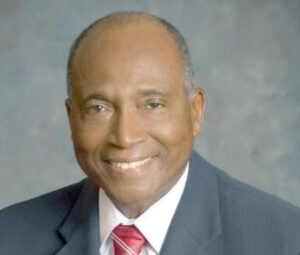 Charles Edison Smith earned his B.S. from California State Polytechnic University, his J.D. from Georgetown University Law Center, and his L.L.M. from Duke University. He is an active member of the California, New York, and North Carolina Bars. In 1973, he became one of the first Black patent attorneys in the U.S. after passing the United States patent bar exam. Today, he is believed to be the most senior living Black patent attorney in the nation, and the first and most senior Black patent attorney practicing in North Carolina. He was also North Carolina’s first Black professor of patent law and is believed to be the first in the nation. As one of the earliest Black patent examiners in the U.S., he has inspired generations to pursue careers in patent law.
Mr. Smith’s work has encompassed all types of legal practice environments. He began as a patent examiner at the U.S. Patent Office, then served as counsel for Bechtel Corporation and later worked as a patent attorney for Xerox Corporation, where he contributed to securing patents for significant innovations. He also worked as an attorney advisor for the U.S. Army Corps of Engineers and the U.S. Information Systems Command, where he became an expert at deciphering the rules and regulations of government contracting — a talent that also has served his clients well over the years.
A dedicated legal educator, Mr. Smith began teaching at Golden State University before joining North Carolina Central University (NCCU) in 1979. There, he launched courses in patent and intellectual property law, corporate and agency-partnership legal courses, and helped found NCCU Law’s Intellectual Property Law Journal as faculty advisor. He served as associate dean for many years and earned NCCU Law’s “Professor of the Year” award. He authored numerous publications and led programs in intellectual property, contracts, and sports and entertainment law.
One of his highly valued and enduring contributions to legal education is the Performance Based Admissions Program (PBAP), co-founded with Professor Mary Wright. Established 40 years ago, and to quote former Judge Fred Williams, PBAP has allowed, “intelligent individuals, many of whom are minorities, an opportunity to attend law school by taking into consideration more than just the required standardized test scores…[PBAP admission] is offered to a limited number of applicants whose credentials do not qualify them for unconditional admission, but whose records nonetheless show promise of success.” PBAP has helped launch the legal careers of many outstanding attorneys in North Carolina and beyond who might not have otherwise accessed the profession.
Mr. Smith founded NCCU’s Intellectual Property Law Institute in 2016 with support from SAS Institute. As founding director, he created a space to train minority students in IP law. Initially, students collaborated with the Patent Office to review and help invalidate suspect patents. The Institute later expanded into a clinic providing IP services to underserved communities. It also supports the broader community through seminars, workshops, and programs where entrepreneurs and the public can engage with experts on key IP issues, strategies, and resources. Today, nearly a decade later, the Institute remains a vital resource for both students and the public, promoting diversity and access in intellectual property law through education, service, and outreach.
While teaching at NCCU, Mr. Smith maintained a part-time legal practice with Olive & Olive until ABA changes restricted it. After retiring, he rejoined the firm as “of counsel” and continues practicing patent law in Durham, NC. Notably, he helped achieve a ruling affirming that Internet Archive content does not automatically make information publicly available.
Mr. Smith is married to Dr. Queen Elizabeth Utley-Smith (“Queen”), and they have one adult daughter.