

35-time Ironman Competitor David Daggett on Building Habits That Last
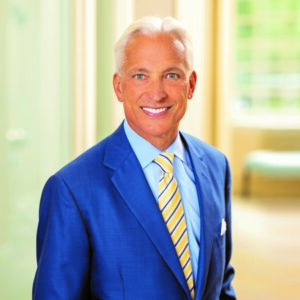
David Daggett
Every meaningful achievement begins with a specific, and often simple, goal. Setting a goal is the easy part of this process, but fostering habits that will make those goals a reality can take time and significant effort. To accomplish what you plan to do often involves not only forming new habits but staying consistent in practicing them.
But if you do develop those habits, you reap the rewards. Realizing a goal produces change in you, and it also often influences the people around you because you have inspired them and helped them to see what is possible. Your determination can make a lasting difference in someone’s world.
David Daggett, an attorney in Winston-Salem, demonstrates determination in his athletic training and legal career. Over the past 45 years, Daggett has completed 35 Ironman races and has plans for his 36th at the Hawaii Ironman World Triathlon Championship in October. He balances his triathlon training with spending time with his family, volunteering with his church and serving in his community.
But he doesn’t stop there: he encourages others to excel in life and to take good care of themselves. One of his favorite volunteer roles is serving as an emcee at 5Ks and other local race events in the city. Another passion of his is pouring into the next generation. He is the founder of the Safe Sober program, which is now in its 36th year. As part of that program, he speaks with teenagers and emboldens them to navigate their middle and high school years safely and responsibly.
How does he do it all?
In our conversation, Daggett shares that he has a solution for how to stay consistent in working towards his goals. He has found a way to make exercise habits a part of his day, year and life. Rather than seeing exercise as separate from his career, he sees it as foundational to all that he does.
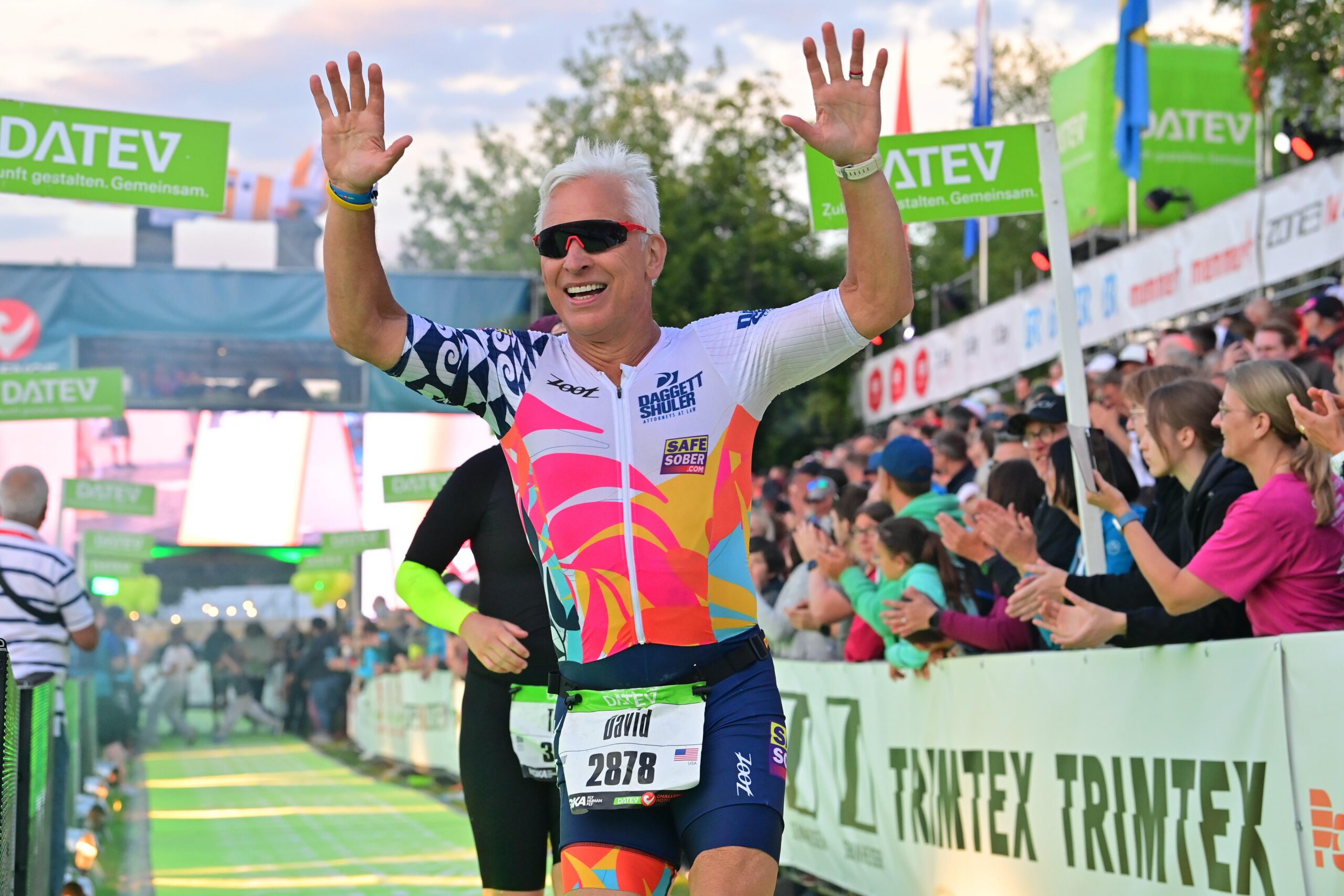
Daggett completes the Challenge Roth Ironman race in Roth, Germany, 2024.
At 21 years old, while he was in college at Indiana State University, Daggett completed his first triathlon. When he began training, he had no background in biking, swimming or running, but he had always enjoyed athletics. As a high school student, he was a football player and wrestler. Since his first triathlon competition, he has completed at least one race every year. Ten of them have been the Ironman World Championship in Hawaii.
As he continues to pursue his goals, nothing has stopped him — not even cancer. He finished his most recent Ironman race in November of 2025, despite having recently been diagnosed in April of 2025. Now, he is speaking out about how important it is for men to get tested for prostate cancer. Doing so is crucial, he shares, because there is a 95 percent rate of survival when this type of cancer is caught early.
One might think that receiving a cancer diagnosis would cause someone to slow down, but Daggett responded in a different, and he feels, more productive way. After learning he would need to undergo treatment, he asked his doctors if he could wait until he had completed the November Ironman. They said yes.
When others speak to him about his accomplishments, Daggett says he is asked one question more than any other.
“How do you find time to do it all?”
His secret is simple: he interweaves his key habits into his life. Through this principle, he completes long training sessions each day. His schedule begins at 5 a.m., when he goes to the gym to swim laps for up to three miles.
Daggett says that this activity sets the tone for everything that follows.
“Everybody says, how can you go up and down the black line of the pool virtually every business day of your career? Going on 41 years, doesn’t that get boring? I said, I’ve got a system that I go through, and it makes me a better lawyer.’
“Scientific studies would show this, that if you spend every morning in a period of gratefulness / prayer, you’re going to have a better day. If you bullet point and outline your day, you’ll be more efficient and more productive. Then quiet time for problem solving whatever your biggest problem is. I’ll do those three things while I swim in the morning, and I’m ahead of the rest of the world before they’re even awake.”
His mornings are devoted to swimming, but that is only one of three activities in an Ironman race, which consists of a 2.4-mile swim, a 112-mile bike ride and a 26.2-mile run. To train for the second portion, he often darts out for a run on his lunch break. Long cycling sessions, his favorite, are built into and around volunteering for community activities, usually on the weekends.
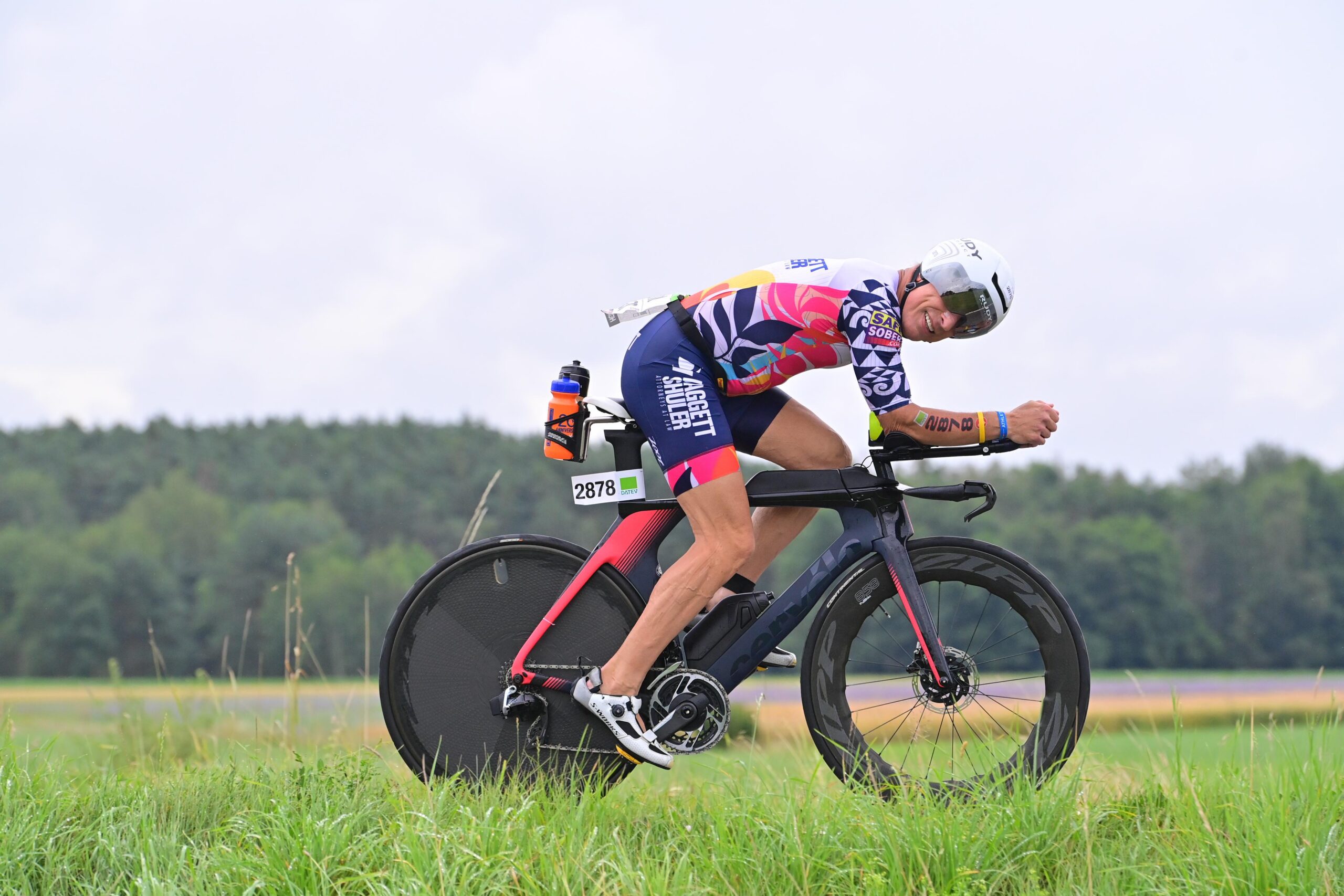
Daggett bikes during the Ironman World Championship, Kona, Hawaii, 2024.
“If you integrate the system, it works together. So, I have tried to integrate my physical life, my professional life, my family life, my civic and church life in a way that it works together on an ongoing basis. And I believe integration is the key. You don’t want to segment it. You want to integrate it. Once you understand the principles of integration, it works much better.”
What are some other ways he integrates exercise into his daily routine?
“My deal with my wife was, I’ll go any place, anywhere you want to go anytime, as long as I can ride my bike or run one way. Do you want to go shopping? Great. I’ll put my running clothes on under my street clothes, and after we’re done, I’m running home. It was that way a lot,” he said.
“That integrated those things instead of separating them. They sound like silly tricks, but you start stacking those on top of each other and looking for opportunities to do it. And you can do it with all aspects of your life.”
Being able to do what is difficult in these races has empowered him in his law practice, in part because of the principle he has found to be true through intense and lengthy training sessions.
“There’s a book that I’d recently read, something like, why do you do hard things? I listened to a review of it. Doing hard things, for some people, that might be going hiking with your family up Hanging Rock. For some people, it might be going on a walk around the block. But whatever it is, doing a hard thing gives you a resiliency and a confidence that backs up that resiliency that is hard to get any other way.
“I’m still the old athlete that I learned lessons the hard way. But I think the one thing everybody in this firm will tell you, and everybody in town in my profession, is that I don’t quit, and I don’t give up. And hard stuff doesn’t bother me. It’s a developed resiliency that I definitely think Ironman racing has augmented in a very, very positive manner for me.”
His resilience is evident in his training and also in his career as an attorney, which has spanned 41 years.
But how did Daggett, who grew up in Iowa, decide to become an attorney and move to North Carolina?
While in college in Indiana, he began to think about entering the legal field. After his father encouraged him to pursue a professional degree, Daggett considered becoming a dentist or a doctor, entering the military or becoming a lawyer. Sometime during his second year in college, he realized that the non-science majors were, as he says, having more fun than the science majors, who were spending afternoons in the lab.
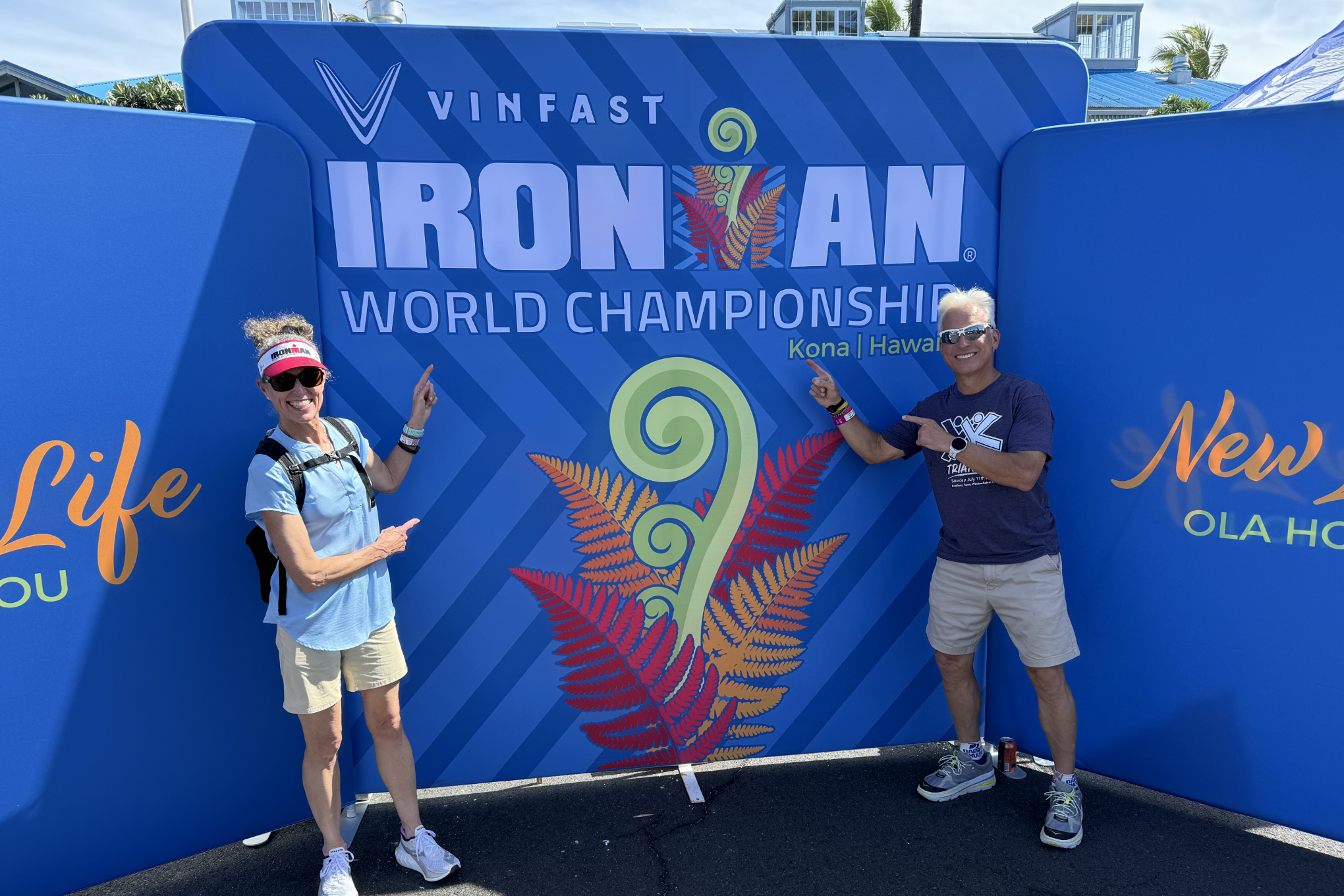
Daggett, right, and wife Cynthia, left, at the Hawaii Ironman race, 2024.
“I was actually late in declaring a major in economics, but got pretty involved in economics, English, history and political science. And those subjects resonated with me and fit together. And I said, maybe the law is the path that’s calling me.”
After his years in the Midwest, Daggett was eager to explore a new area of the United States. He applied to Wake Forest University School of Law, which at the time, had a rolling admission.
When he learned that his application for law school could be enhanced with an in-person interview, he drove to Winston-Salem to meet with administrators from the law school. He was accepted into law school before the beginning of his senior year of college.
His first visit to Winston-Salem and his first semester in law school marked a new beginning. His experiences sparked in him a lifelong love for North Carolina.
advertisement

“The biggest shock in my life was when I got to Wake Forest University, and there were no palm trees because I thought I was in the South, and I’d never been in the South before. My parents lived in Chicago at that time. I had my whole life planned as to where I was going to go. I knew where I was going to live near Lincoln Park in Chicago. I had my whole life planned out.
“Then, I came down here for my first semester of law school. I went home at Christmas and told my parents, ‘I’m staying in Winston-Salem the rest of my life. I love it here.’ And I still feel exactly the same way.”
Daggett has an abiding passion for the city and for the people in it. He began his career in general practice with some experience in criminal law, before his focus narrowed to representing clients in wrongful injury cases, primarily automobile accidents, as well as workers’ compensation cases, malpractice and Social Security disability hearings. Now, he focuses on wrongful injury, workers’ compensation and Social Security disability.
During his many years as an attorney, his priority has been to support each client.
“With no doubt, as an attorney, the most rewarding part is working with each and every individual. I like people. The only thing I have done my entire career is represent individuals, real flesh and blood. And I hug them, I cry with them, I celebrate with them, but each and every individual is a separate story. And each and every one of them has touched me in some way, shape or form and still does. I just absolutely love it.”
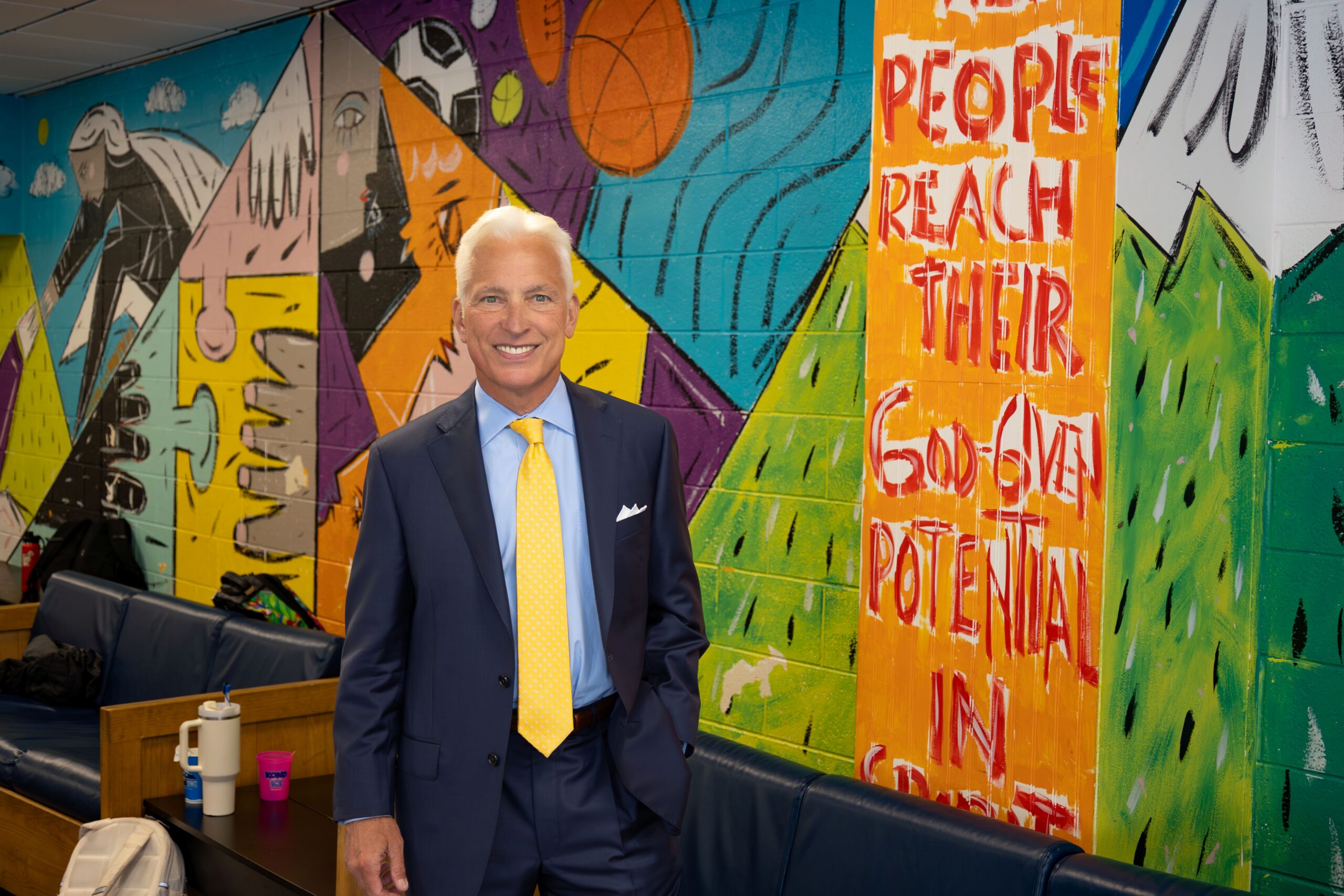
Daggett is photographed in the Safe Sober Teen Center, located in the William G. White Jr. branch of the YMCA.
Like his unwavering determination to become an even better athlete, which continues to grow each day, his deep resolve to care for others has expanded following his cancer diagnosis. He has a profound sense of gratitude to have been diagnosed quickly — and he credits the discovery of the disease to his training.
In October 2024, while biking during his 10th Hawaii Ironman race, Daggett noticed that something felt off.
“My bicycling is my super strength. I’m very, very comfortable on a bike. I can hold a very aerodynamic position on a bike for a long time, which is hard for a lot of people to do. About 80 miles into the Hawaii Ironman, I was uncomfortable on my bike seat. I was scooting around. I told my wife after the race that I didn’t have a particularly good day,” he said.
Since his annual physical was approaching, he mentioned it to his doctor, who had been his internist for 30 years. His doctor said that the discomfort was probably nothing, but he would order a PSA test as a precaution. When the results came back, the test showed a small spike. Next, Daggett visited a urologist who recommended an MRI, and two days later, Daggett received a phone call. The doctor said that Daggett had a one-centimeter tumor.
The following day, Daggett met with the doctor, who said he needed to get a biopsy. Daggett had one request.
Could the biopsy be scheduled after his upcoming Ironman race, which would be held in April?
The doctor said yes.
“I was afraid the biopsy would put me out of commission from sitting on a bicycle seat for a while, which it did. He scheduled the biopsy for the day I got back, which was April 11, and the biopsy came back positive. The good news is that it was a non-aggressive form and completely contained. If you catch it within the walls of the almond-sized prostate, and you follow up and get the proper treatment, you have a 95% chance of survival,” said Daggett.
“If you let it get outside the prostate, that percent chance drops to in the 30s. That’s why it’s so important for men to stay on top of their health. You catch it early, you win. You catch it late, you lose.”
After his race in April, Daggett did not turn inward but rather began to ask himself how he could help others even as he was being treated for the disease.
“I told my wife, I’ve done everything else with gusto. Let’s do this with gusto too. So I turned it into a positive. I sought out, how can I be a help to the community?”
He became an advocate for men’s health and early testing by speaking at local events, being a guest on local radio shows and being interviewed by local news stations to share the message in as many places as he could.
“Men, drop the ego — get testing. If you have something that’s suspicious to you, like the bicycle seat was to me, tell your physician and be an advocate for your own health, and let’s get ahead of the curve.”
Because of his reach, a number of men have been tested and diagnosed early. He shares two stories of men who said how grateful they are that they heard his message and took his advice. One man stopped by Daggett’s office. Although Daggett was out at the time, he was moved when he learned afterward what the man shared.
The man said, “Just tell Mr. Daggett I went to my doctor and got tested, and they caught mine early because of his story.”
Daggett also says that, at least once per week, a man will approach him at his local gym to share his story — that he got tested and diagnosed early. While walking downtown recently, a man approached Daggett and his wife to say he also was tested and caught the disease before it could do great harm.
Daggett somehow found time for many speaking engagements even while continuing to train for his November 2025 Ironman race. He had asked his doctor if he could schedule a follow up after the race, and the doctor agreed.
“Continuing to amplify and spread that message on men’s health has been cathartic for me, but very, very helpful for others,” said Daggett. “It probably sounds a little silly, but as part of my men’s health message, I want to show to myself, but also to men, that we can continue to thrive. And honestly, I needed that message to myself. I had to know that I could still do what I thought I could do. And in November of 2025, I ended up executing my best age-weighted race ever. I won the age group. This one was in an international field.”
He is also glad to share that his tumor has shrunk in half, and his PSA levels are low. Although it is something he says he will continue to deal with on an ongoing basis, he focuses on the good that has come from it. His diagnosis has only made him even more committed to living life with the same energy and drive for helping others he has had since the beginning of his athletic and professional career.
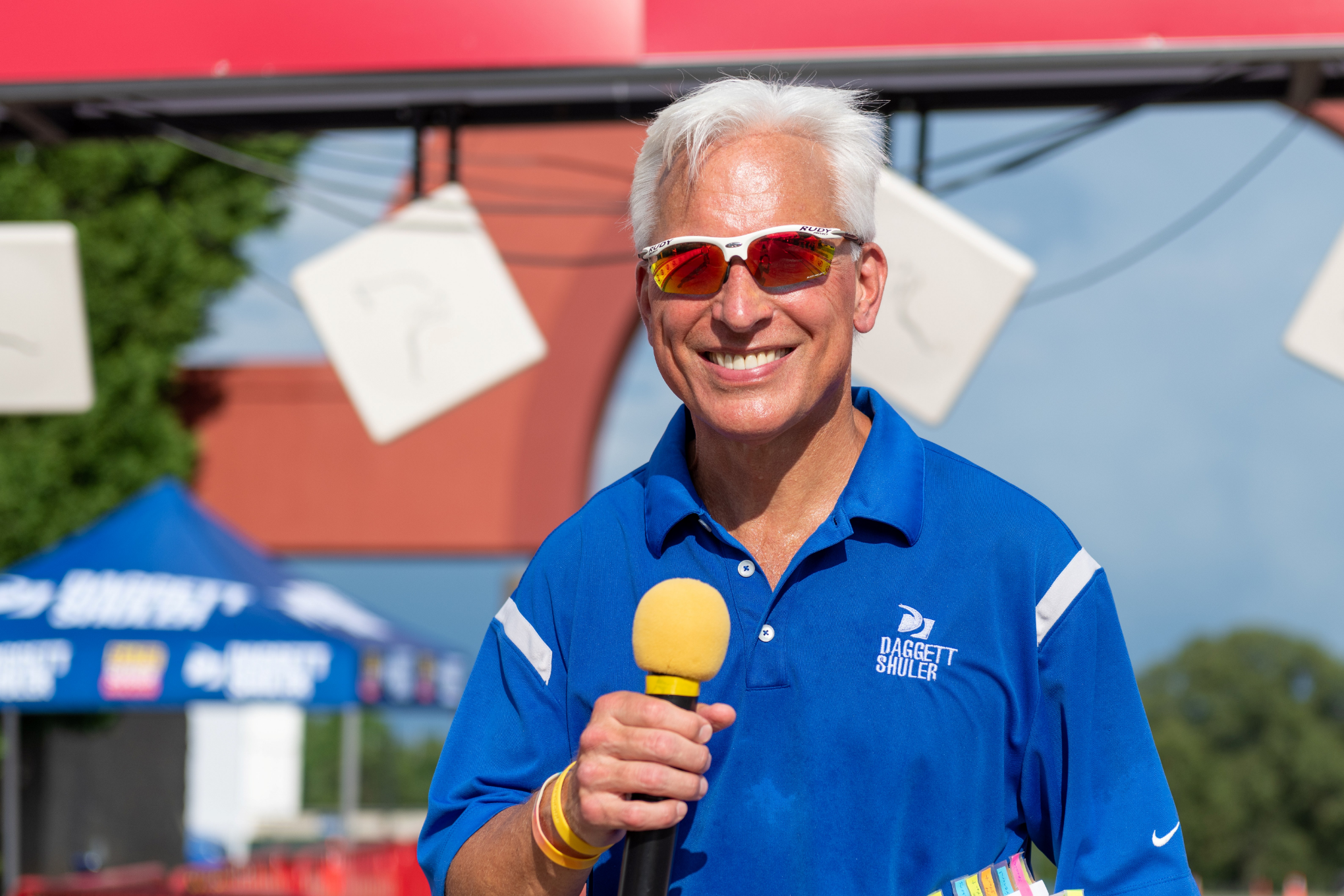
Daggett serving as the emcee for Beat the Heat, NC State Championship 5K, Winston-Salem, 2021.
His hope is to impact others through his work as an attorney and advocate for men’s health and to inspire others to achieve their goals. One way Daggett has been a model for others in the profession is through his service with the NCBA.
Daggett joined the association in 1984 and served as a member of the Board of Governors. He also helped to launch the North Carolina Conference of Bar Presidents, which was a joint committee between the State Bar and the North Carolina Bar Association. Daggett served on the executive committee for the conference for ten years.
The NCBA has altered the trajectory of his career.
“One of the things that was so beautiful is because I was involved with the North Carolina Bar Association as a young lawyer, I had all these resources available to me. Those led to broad and expansive relationships that, to this day, are a significant platform for my career.
“There are the educational components. But more than anything else, it’s a platform for positive relationships across the state that I have found have supported me in ways that I could never have forecasted when you start those relationships a long time ago.”
Because of the way his membership has benefited his life, Daggett shares a story of how he recently spoke with a new attorney about the value of connecting with others in the profession.
“It creates a platform for your professional career in a positive way. I think one of the things that I’m trying to impart on younger lawyers is, what everybody’s looking for today is immediate response, immediate gratification. And that’s all well and good,” he said.
“But those old-fashioned relationships, I think that’s very, very important. It is something that we need to emphasize, share, and lead the younger members of our profession in developing those relationships because they are a platform for both a successful career and a very fulfilling career.”

Beyond speaking with new attorneys, Daggett has inspired another member of a younger generation to set goals and achieve them. In July of last year, he completed the Escape from Alcatraz Triathlon with a very special person: his daughter.
Competing in this race together was meaningful because of what his daughter had overcome since October 2022.
His daughter, who was attending Columbia University for graduate school, was in a rural area, where she was leading triathletes on a bike ride. Without any warning, she was struck by a car, and the impact shattered her leg. She had to undergo major surgery. Daggett remembers the many emotions he felt when the doctors said that they were optimistic that she would walk again.
He is beyond thankful that she made a full recovery. In 2025, she was invited to compete in the race in San Francisco, and Daggett joined her as a participant. As part of the race, participants take a ship to Alcatraz Island, where they jump off of it, swim to shore in San Francisco Bay and then bike through the city’s famous hills.
The path continues with a run under the Golden Gate Bridge, down through to a beach and up a sand ladder with 400 steps up the cliff. The final stint goes back under the Golden Gate Bridge to the finish line.
It felt different from any other race.
“Doing that with her was one of those real joys of a lifetime that I’ll never forget,” he said.
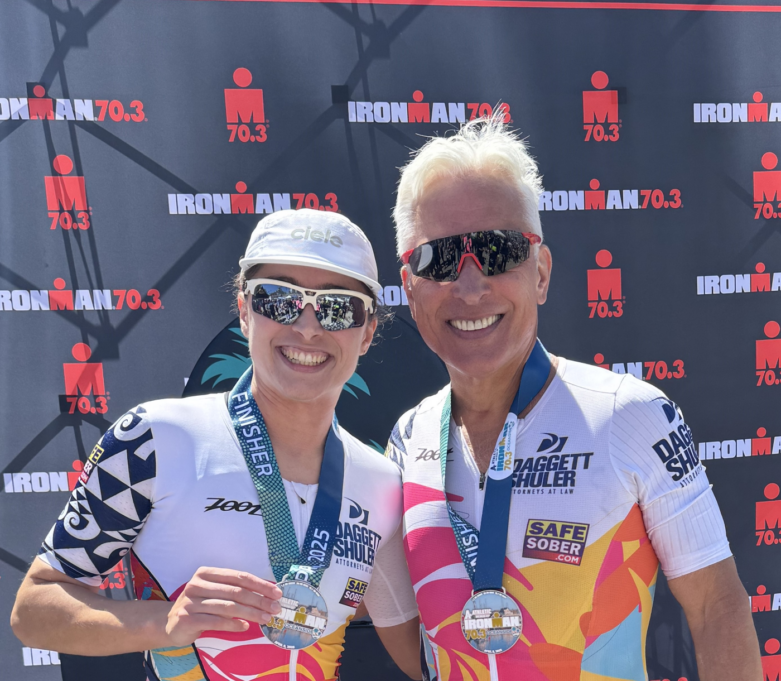
Daggett, right, and daughter Annecy, left, completed the Ironman 70.3 Oceanside in California, 2025.
Daggett, who plans to complete the same race again this year, describes that the metaphor of training can extend into so many things, including one’s approach to their legal practice and to their life. In his volunteer role as an emcee, he sees the impact of habitual athletic training up close.
Daggett says there is something that transpires on the finish line that is unlike any other moment in life.
“The most beautiful thing to me is people’s faces and eyes crossing a finish line. As the emcee, that’s where I’m standing, and I get to see each and every one come across the finish line. And I always say the finish line is the most valuable real estate on earth. Nobody can give it to you. You can’t buy it. The only way to get there is to get there yourself,” he said.
“And I don’t care if you’re big, small, old, young, fast, slow, it makes me no difference. When I see that face come across the finish line, I mean, half the time I cry. I light up and I’m so excited that they’re so excited. And I never forget that for many, many people, it’s a monumental and many times a life-changing event just to cross that finish line. And I love it.”
In his career and his athletic pursuits, Daggett has proven that there is power in integrating healthful habits into one’s daily life. This power is significant not only for what it has done in his own life, but for the way it spills over and energizes, fuels and touches the lives of so many others.
Jessica Junqueira is communications manager for the North Carolina Bar Association.