

Collins Saint Guides New Sexual Orientation and Gender Identity Committee
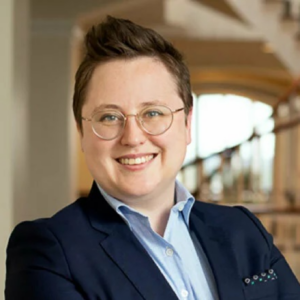 Just as every oak tree begins as an acorn, so too does every section or committee of the North Carolina Bar Association begin as an idea. One determined individual with a keen interest in a particular topic, issue, or area of the law seizes the initiative to bring their peers together to discuss it further – to listen, learn, educate and inform. When the Sexual Orientation and Gender Identity Committee was established last year, such an individual had already stepped forward to outline the importance of officially forming such an entity. Their name is Collins Saint, an associate with Brooks Pierce in Greensboro who focuses their growing litigation practice on matters relating to education law.
Saint is by all accounts a rising star within the legal profession, the North Carolina Bar Association, and the NCBA Young Lawyers Division, where they currently serve as secretary. A 2017 graduate of Wake Forest University School of Law, they also hold a bachelor’s degree in psychology and a master’s degree in school counseling from the University of Alabama. On a more personal note, as denoted on their firm website, Saint has fostered three animals including a minipig, watched the movie “Grease” more than 300 times, and is three years in remission. Thankfully, all is well now, but their battle with non-Hodgkin’s lymphoma did make a lasting impact on Saint that they discuss later in the interview.
But for starters, let’s hear a little bit more about the evolution of the Sexual Orientation and Gender Identity Committee, or SOGI for short, from the founding chair.
How did the idea to establish the committee come about?
Ever since I was in law school, I really hoped for something like this. Coming to North Carolina, not knowing much of anybody when I got here, it was really important for me to find a way to connect with LGBTQ+ and allied attorneys. I wanted to find the space to do that, and I looked around with some of my friends in law school, including Drew Culler who is the current vice chair of the SOGI Committee, but we didn’t find a whole lot that was going to meet that need in North Carolina. Ever since then, Drew and I spent a lot of time brainstorming and thinking about ways that we can make that happen.
I got really involved in the North Carolina Bar Association through the YLD as one of the first co-chairs of the Diversity and Inclusion Committee. As I grew in that role and grew in my work in the YLD, I started to understand just how great of an organization the NCBA is, and that this could be the right fit for this group that Drew and I had been pining for. It’s statewide, open to all practice areas, includes law students, and has the infrastructure to support a burgeoning group.
What were your first steps?
I talked with some NCBA leaders, and they advised us to put together a prospectus to present to the president at the time, Mark Holt, and Executive Director Jason Hensley. Mark thought it was a great idea and showed incredible support for us, so we kept having meetings and we kept having conversations. When Mark became immediate past president, and Jon Heyl stepped in as president, he shared Mark’s enthusiasm. (Mark was one of the first to request to be appointed to the committee.) We were finally able to make it happen after about 18 months of hard work, and now we’re here, a fully formed committee with members, funding, and goals.
How did you manage to rekindle the idea after law school?
After we graduated law school and settled into our practices, Drew and I continued talking about how we felt that something like this was missing. We saw a need and wanted to figure out a way to fill it. We then started talking about it more seriously with some other graduates of Wake Law. It’s been definitely a team effort to get it started, and I am glad we had a diverse group with varied experiences to think through what was needed. It turned out that we were not the only ones who really wanted something like this in North Carolina.
Is the need even greater than you might have imagined?
The last I checked our initial roster for the committee was over 80 people, which is enormous for an NCBA committee and really shows the need that was there of people wanting to connect with other LGBTQ+ attorneys, as well as people wanting to grow in their abilities to serve LGBTQ+ clients and to develop CLEs around that space. We also have a great pro bono component. There’s a lot of need for that in our community, and it is something that we’re all really passionate about. I am excited that we were able to make the committee happen and that there’s still so much interest in it.
We’ve existed for less than a calendar year, and we’ve already contributed to multiple CLEs and had social events. Now we have a budget, which is exciting and will help us connect even more. We’ve been working on putting together a strong name change and gender marker correction clinic, and thinking through how to have microgrants for people who can’t afford all of the requirements to have a name change. The process is incredibly expensive. We can volunteer attorney time, but there are filing fees and background checks, and then you’ve got to get certified court orders, and then order a new birth certificate and driver’s license. The other expenses can cost somebody anywhere from $500 to $1,000 to change their name. That’s cost prohibitive for some people, so it’s really important that we’d be able to provide some funding to support that. We’re working on connecting with law student groups to connect with the next generation of lawyers. And I’ve recently been in talks about a drag event that’s hopefully going to happen in spring for the North Carolina Bar Association, so there’s a lot of fun stuff happening along with the serious business. But all of it is very exciting.
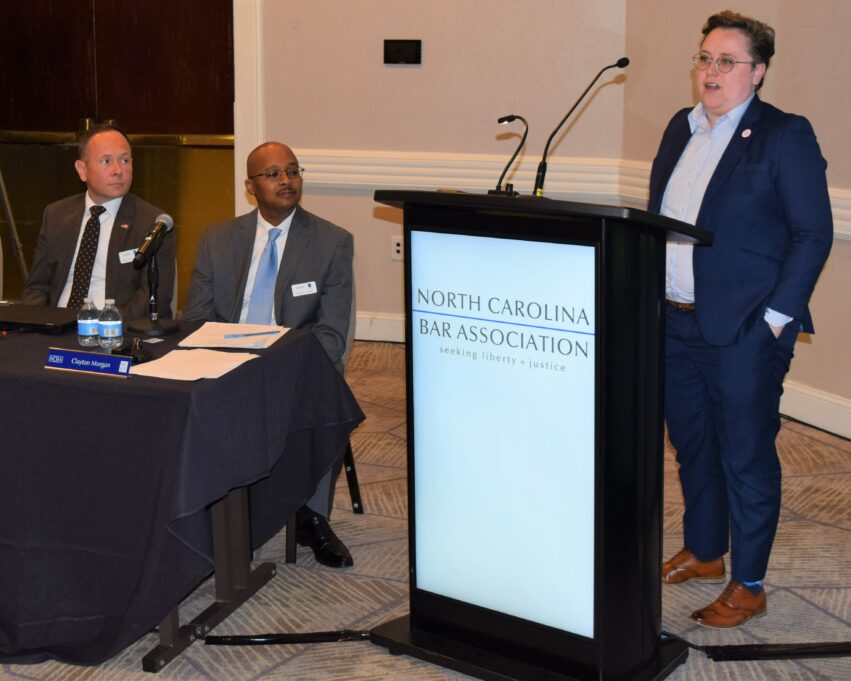
Collins Saint presents at the NCBA Board of Governors meeting as Executive Director Jason Hensley, left, and President Clayton Morgan look on.
How did you settle on a name for the committee?
We toyed with a couple of other names and ultimately settled on this one because this is what the American Bar Association calls their similar groups. The American Bar Association has a SOGI Commission as well as a Young Lawyers Division SOGI Committee, and I’ve been on both of those. I was the chair of the SOGI Committee for the American Bar Association last year. I think it rattles off the tongue better than a long-winded acronym – LGBTQ+ Lawyers in North Carolina, or something like that. SOGI is just fast and memorable, and I like that.
It sounds like you have built some important relationships along the way.
Oh yes. Through the YLD, I fortunately got to know Cabell Clay and Rachel Blunk, and they helped me know who to talk to and what to talk to them about. They’re both former chairs of the YLD, and mentors and friends of mine. They were very, very, very helpful in helping me know the kinds of things that were important to the Bar Association for our pitch. Fortunately, they were the kinds of things that were important to us too, so we were able to have good conversations with Mark Holt and with Jason Hensley, and we moved forward fairly quickly. Eighteen months may seem like a long time, but not for an organization as big as the NCBA. I know that good things take time, and I was very excited that we were able to get it going that quickly and in the midst of the pandemic.
I think it really speaks volumes of the support that the NCBA has for making sure that our profession is an inclusive one. SOGI is a way that we can increase the inclusion of LGBTQ+ attorneys in the profession, and also do a better job serving LGBTQ+ clients. Like MIP (Minorities in the Profession) and WIP (Women in the Profession), this is an interesting committee where the members of the committee are not the full constituency that the committee serves. That is really important for us – making sure that we are able to market our events, our pro bono opportunities and our CLEs to all members of the bar who may be interested, whether they’re on the committee or not. Only so many people can do committee work, but there are so many people who can be involved in the events and activities that we have planned. We’re trying to figure out the best way to do that, and I want make sure that that we’re doing a good job serving all the folks in the NCBA who would be interested.
Now that you’re up and running, what’s in store for SOGI?
We just had a social with the Litigation Section in Durham, and we are working toward having a drag event which will be both a social event as well as an awareness-raising opportunity for our committee work, especially our pro bono work. A drag event will be a chance for us to have a whole lot of fun together and celebrate our community, but also raise awareness for something that’s really important to us.
We’re also going to have gender marker correction and name change clinics for transgender community members so that they can receive free legal information on how to accomplish those goals in North Carolina. And we’re working on a couple of CLE goals. One is going to be putting together a list of attorneys in the NCBA who are LGBTQ+ and who are also experts in their field. Minorities in the Profession has already done this for attorneys of color, and it is such a great idea that we had to adopt it. For instance, I was one of the CLE chairs for the Education Law Section last year, and we got a list from the Minorities in the Profession Committee. They said, “Hey, I see you’re planning an Education Law CLE, and here are 11 attorneys of color who know a lot about education law who would be interested in speaking.” And we were able to contact several of those lawyers and make sure that we had really great, diverse panels and speakers at our CLE. We want to do the same for LGBTQ+ attorneys to give a chance to elevate our voices and expertise as well.
We’re also working to put together what we call a CLE-in-a-Box, which is basically a straightforward, generalizable CLE on language and things that every practitioner should know when representing an LGBTQ+ client. It will be an hour-long CLE and we’re going to make sure that it meets the ethics requirements. It will be easy to deploy for any section or division to incorporate into their own CLE program if they are interested in this topic.
And then the last piece is that we’re working on putting together is a CLE of our own. This is a really important topic – serving LGBTQ+ clients – and there are a lot of legal issues that impact the LGBTQ+ community in ways that people may not think about.
You know, people think about family law when they think about LGBTQ+ issues, but it’s not only family law. They impact education law, corporate law, business litigation, employment law, housing issues, criminal law, and the list goes on. And even if it is family law, there are a lot of nuances that people assume Obergefell fixed. My friend (and committee member) Milan Pham has taught me on a number of occasions that there are still so many pitfalls for same-sex couples. So it is important to make sure that practitioners stay up to date on how the law impacts their LGBTQ+ clients so that they’re able to do a good job advocating for them or advising organizations who interact with LGBTQ+ community members, which is all of them.
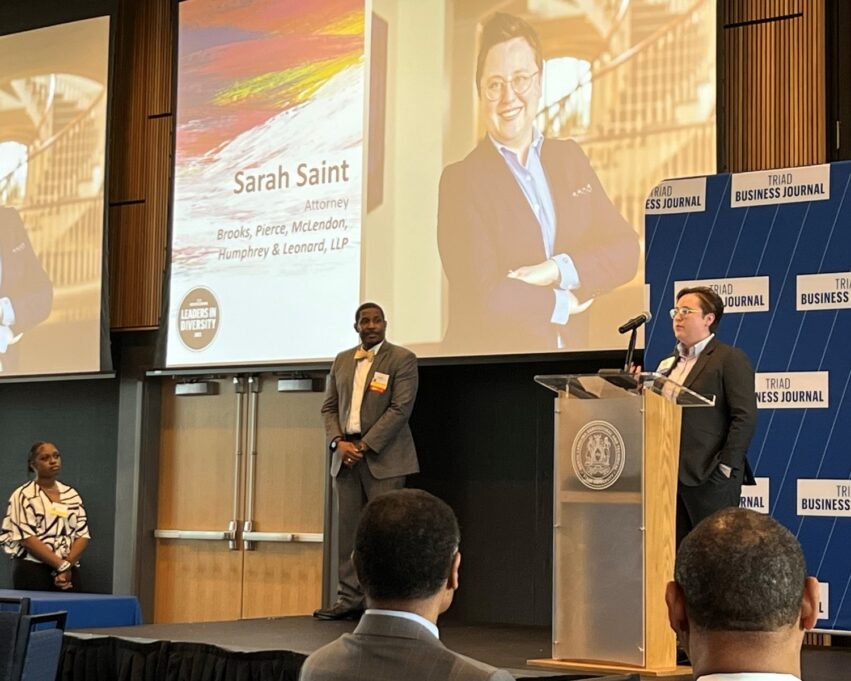
Collins Saint was honored earlier this year as one of the Triad Business Journal’s Leaders in Diversity.
In addition to getting SOGI up and running, you were also on point for important changes to the YLD bylaws that were undertaken last year. Tell us how that came about.
Our bylaws, like so many other organizational documents, used gendered language. It was really important to make sure that our bylaws were inclusive of everybody, regardless of their pronoun usage or gender identity.
The bar went through a movement decades ago where it worked to change all corporate documents from just using “he” language. Instead of saying, “the president of this organization will …” and “he will … ,” we made all these changes, so now they say they would say, “the president of this organization will …” and “he or she will … .” That was great movement and important movement, but not everybody uses “he” or “she” pronouns. Some people use “they,” “them” and “theirs” as their pronouns. Some people use what are called neopronouns, so it could be “ze,” “zir” or a whole variety of other options. And some people don’t use pronouns at all.
It was important to make sure that as more and more people who use different pronouns other than “he” and “she” are entering the legal profession, that they saw themselves in the YLD bylaws, and that we didn’t have language that excluded people who use different pronouns. We changed all the pronoun references in our bylaws to “they,” “them,” and “their,” which is seen as a gender-neutral pronoun for an individual. We made that pronoun change, and in doing so we made other changes to our bylaws, because it was important for us to make sure that we were as inclusive as we could be. We passed the change unanimously with abundant support from the greater NCBA.
The only pushback we heard was that some people think of “they” and “theirs” as being plural pronouns, but we use it in the singular form all the time. Maybe we don’t think about it, but we use it frequently. Think about if somebody leaves a sweater in a conference room, and you walk into that conference room after everybody has left, you say, “Oh, man, somebody left their sweater here. I wonder whose sweater this is. We should make sure we get it back to them.”
How do you find the time to do all of your volunteer work and maintain a successful law practice?
I am very structured in my time. I make sure that I plan my days well with task batching and day theming and time blocking and other gerunds. I like to get up early and get started early. If I am not at the gym first thing, I am at my computer so that I can get what I call “deep work” – brief writing, researching, strategizing – done first thing in the morning before my phone starts ringing. And then for the rest of the day, I have time to focus on whatever may pop up – meetings with clients, meetings with my team, or meetings with NCBA or ABA entities, to move forward with our goals. I also try to do double-duty when I can, like while I am in the car on the way to an NCBA meeting, I’m also on the phone with a colleague.
I also have a very robust to-do list that I maintain religiously. If something is not on the to-do list, then it is not getting done, and that includes laundry. But if it does make it onto the to-do list, it is absolutely getting done. I make sure that I stay on top of that.
Then the last bit, and the most important thing, is surrounding myself with good people. We’re in this together, and none of us are at it alone. Relationships and connections are crucial. Take the SOGI Committee: While sure, I had a hand at getting it started, this committee wouldn’t be plowing forward at a clip without dozens of invested, innovative, and hardworking members. I think it’s really important to foster that kind of community in volunteer work, as well as making sure that the work is interesting and exciting. When you keep relationships in mind, the work is easy. It also helps us to remember that we’re all volunteers here, and so we need to plan ahead enough that if something happens, you know somebody has a trial or a big closing, that there’s enough in the works that it will not fall through.
Has your firm been supportive of your many volunteer activities?
Oh my goodness, yes – my firm is incredibly supportive of my work with the NCBA! As I’m sure you know, there is a long list of Brooks Pierce attorneys who have held high leadership roles within the NCBA, including recently Kearns Davis as president and Will Quick as chair of the YLD. The firm has been incredibly supportive of this involvement, helping me carve out time to do the work and celebrating that this is a component that matters to their attorneys. Bar leadership and dedication to our profession is something that is very important for Brooks Pierce.
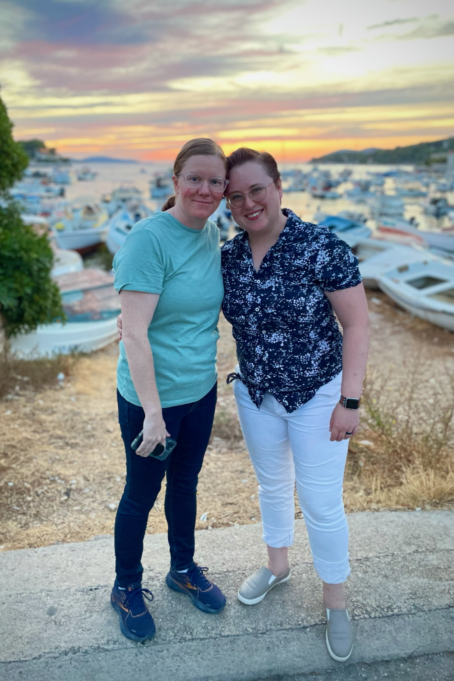
Collins Saint with their wife, Kim Marston, who also practices with Brooks Pierce.
Did you always know you wanted to be a lawyer?
No, actually, that’s not true at all! I had no interest in being a lawyer, as hard as that may be to believe. I really cared about education, and public education a lot, and beginning in middle school was thinking about how I could impact public education. I think it is so important to our society to have good public schools and that we invest time and resources to our children. That’s how I came into my career – planning to be an educator.
I got my master’s in school counseling and really thought that that was going to be my path. But what I learned is that I’m not all that great with children! It takes really special and important people who have that knack to connect well with kids to be formative in those sorts of roles. And I could tell that I just wasn’t going to be transformative in that way, and that wasn’t going to be good for kids and it wasn’t going to be good for me.
I spent a lot of time soul searching and thinking through, well, what can I do that will impact public education in a positive way that will serve kids that doesn’t involve me working with kids. And that is how I stumbled upon the law. Truly, I learned that public school districts have attorneys, of course they do, and they need attorneys to advise them about ways to serve children and to advocate for public schools in courtrooms and in legislative bodies and state and federal government agencies to make sure that they’re able to serve kids in an effective way. And that’s how I found my way to the legal field. It was very surreptitious, but we got here.
And that is how you landed in education law?
Oh yes. My practice is about 75% education law right now and steadily growing. Most of what I do is a wide variety of education litigation, but I also do a lot of advising school districts mostly on issues related to students – a lot of issues related to kids with disabilities, special education needs, compliance with Section 504 of the Rehabilitation Act, as well as other civil rights issues.
A big issue right now in public education is laws impacting transgender students, including privacy rights and Title IX, as well as some First Amendment issues for teachers related to that. There are a lot of intersecting laws that land at the transgender student issue that actually are very complicated issue when you take civil rights into consideration. I spend a lot of time working with clients on figuring out case-by-case what is the best route in any particular situation.
Finally, and most importantly, congratulations on being in remission! Please share how this diagnosis came about, how you dealt with the treatment, and how this process has impacted every aspect of your life moving forward?
Thanks so much! Where to begin? When I was a little over a year into practice, my skin started feeling really itchy. It was winter, though, and I thought I just had dry skin. And then I developed a dry, unproductive cough that wouldn’t go away. Again, winter – could be anything. I also lost a lot of weight, which at the time I was happy about because of the diet culture we live in. The cough turned into severe chest pains and I was really short of breath. If I spoke for over about a minute, I would have to stop to clear my throat – not great for a litigator.
I began having to take the elevator at work because I would get so short of breath going up the stairs. The heart rate monitor on my watch kept alerting me that my heart rate was very high when I was not doing anything strenuous. I was working on a big investigation at the time, and working very long hours, which meant I wasn’t working out at all – I assumed I was just really out of shape from that. Chest pains weren’t new to me either. I have dealt with generalized anxiety disorder since I was a teenager, and it manifests itself as heartburn and chest pains. Working on the case that I was, an anxiety flair seemed reasonable. So I didn’t do anything about it. I wanted to focus on the investigation and I had a federal court brief due in a week or two, so I did not want to take the time to go to the doctor. I was 28 – it was probably nothing more than stress, and I wanted to show that I could handle the stress as a brand new attorney.
Thankfully, after about a month of the severe symptoms, my now wife Kim Marston insisted that I go to urgent care. She was convinced I had walking pneumonia. The afternoon after I had to sit down on the porch steps while carrying in groceries because I was so out of breath, she drove me herself as I continued to send emails to the folks I was working with. Urgent care sent me straight to the emergency department with EKG results that said “possible heart attack.” The emergency department ran a bunch of tests, and we learned that I had one fully and one partially collapsed lung, a pleural and pericardial effusion, deep vein thrombosis in my jugular vein, tachycardia, and a tumor the size of a melon in my chest cavity causing it all. After a thoracentesis to remove 1.5 liters of fluid from my lungs, I gave in, emailed my partners that I would not be able to finish the investigative report or brief, and was admitted into the hospital to try to keep me stable while waiting on a biopsy of the tumor.
I did not appreciate it at the time, but I was at extreme risk of cardiac tamponade or an embolism. I can’t think too hard about what would have happened if Kim hadn’t pried me from my computer to get help.
Within a few days of being admitted, I was diagnosed with a really aggressive form of non-Hodgkin’s lymphoma, primary mediastinal B-cell lymphoma, bulky type, which basically means that my antibody-producing white blood cells had turned into cancer cells and a tumor larger than 10 x 10 centimeters (as opposed to many small tumors) had formed in my chest cavity. Chemo- and immunotherapy started within a week, and I had to formally stop working.
For the next five months, I was in-patient for a week to receive my infusions and then I got to go home for two weeks; back to living at the hospital for another week, home for two; and I did this six times. Within nine months, I was in complete remission with no evidence of disease and the residual tumor was removed. That was a little over three years ago, but it still feels so fresh in my mind.
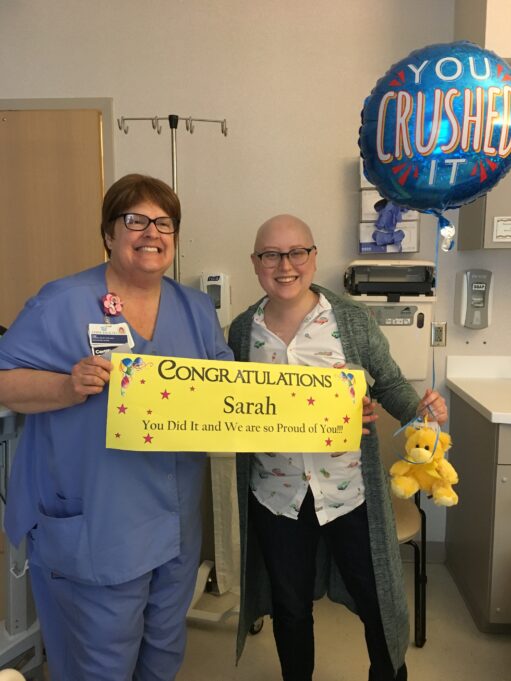
Collins Saint celebrates a significant milestone on the road to remission.
I will never be able to express enough gratitude to my colleagues in the bar. The partner I was working with on the federal brief was the first at the hospital the morning I was admitted – she’d gotten dressed for work, saw my email, and immediately found my room to make sure I had everything I needed. My firm redistributed my work, kept me updated on my cases (because they knew I was interested, not because they expected me to do anything with the information), brought me groceries and Coca-Cola Icees, and really showed me they cared for me as a full human, not someone who owed them a report or a brief.
This experience, and a lot of trauma counseling, have changed how I operate as an attorney and throughout my life. I think most importantly, I am much more authentic in how I practice.
As a new queer attorney in the South, I was really nervous about what people thought of me – I felt the need to be a certain way in order to appear competent and confident. And that way was not me.
When I returned to work after chemo, I was so scared of going to court with a bald head. I hadn’t worn a wig through treatment, though, and I was not about to start. So I did it, and you know what? Nothing bad happened. It was fine. (It was actually very good – I won that motion.) And I felt good afterwards because I had been myself and represented my client well. So I began showing up to work fully myself. And you know what? Nothing bad has happened. In fact, only good things have happened. I am a more confident attorney, my relationships with my colleagues and my clients are better, and I am much, much happier.
That’s another reason SOGI is so important to me. I really hope that we can create a professional environment where other LGBTQ+ attorneys feel safe being fully and authentically themselves in the bar. There is still work to be done, and I am glad to be part of a group of attorneys committed to doing it.
Russell Rawlings is director of external affairs and communications for the North Carolina Bar Association.