

2022 NCBF Justice Fund Honorees Share Bonds of Service and Loyalty
The North Carolina Bar Foundation dedicated five NCBF Endowment Justice Funds in 2022. One was dedicated on June 23 at the North Carolina Bar Association Annual Meeting at the Benton Convention Center in Winston-Salem and four were dedicated on October 19 at the N.C. Bar Center.
The Annual Meeting ceremony was held in conjunction with the law school reception of Wake Forest University School of Law in honor of “Double Deacon” alumnus Leo Daughtry of Smithfield. The October ceremony included the dedication of Justice Funds honoring Joseph B. Cheshire V of Raleigh, George B. Mast of Smithfield, and the late Rudy L. Ogburn of Raleigh, and dedication of the NCBF Endowment’s first Anonymous Justice Fund as well.

Woody Connette introduces the first NCBF Anonymous Justice Fund.
In listening to the words spoken by and about this year’s honorees, the common threads of service and loyalty resonated from Winston-Salem to Wake County to the 100 counties of North Carolina, all of which are touched by the work of the NCBF.
“The Justice Fund dedication really meant a lot to me, and reinforced my feelings about being a lawyer,” said Daughtry. “When I was coming out of law school, being a lawyer meant you were a pretty good member of the community. We were looked up to and that opened doors that normally I could have never opened, and it was a wonderful way to make a living. I am so grateful to the Bar Association for giving me this honor. I am proud to be a lawyer and I am proud that my daughter (Kelly Daughtry) is a lawyer.”
Daughtry served in the General Assembly a combined 28 years in the N.C. Senate and N.C. House of Representatives, and throughout his tenure was highly regarded as a friend of the NCBA. The feeling, he assures, was mutual.
“Being a member of the Bar Association, I served in the General Assembly, and I saw firsthand how important the Bar Association is making sure that the laws that the General Assembly passes are well-educated,” said Daughtry, who was honored by the NCBA Board of Governors in 2016 for his “faithful service in the North Carolina General Assembly on behalf of the citizens of North Carolina.
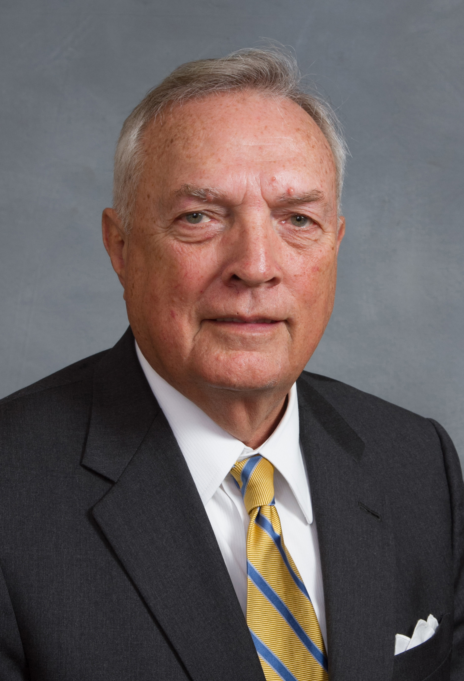
Leo Daughtry
“Any suggestions the Bar Association made were always very important. The Bar Association is a wonderful way for lawyers to be together. They have done so much for our state, not only as the laws are passed, but also in community efforts. Lawyers are always there for the community.”
Accepting his Justice Fund recognition at the law school reception held special meaning for Daughtry.
“It absolutely does,” Daughtry said. “Wake Forest took me in as a young boy off the farm and if it wasn’t for them, I don’t know what I would be doing. I am grateful to be an alumnus of Wake Forest.”
Joseph B. Cheshire V was even a younger boy when he arrived at Groton School in Massachusetts at the age of 12. Following his undergraduate education at the University of North Carolina at Chapel Hill, graduation from Wake Forest University School of Law, and service in the U.S. Army, he entered the practice of law in Raleigh with Ragsdale and Liggett.
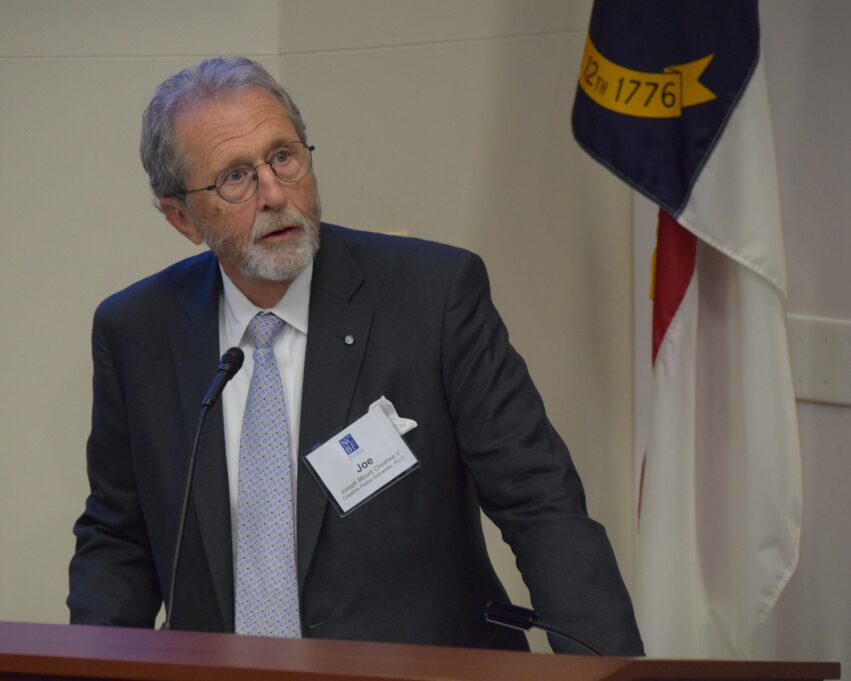
Joe Cheshire
Although trained to defend civil cases, Cheshire has long since established himself as an institution among criminal practitioners.
“The lawyers I have tried the most cases with are Tommy Manning, Brad Bannon, Wade Smith and David Rudolph,” said the senior partner of Cheshire Parker Schneider. “When we started the practice of criminal law, the criminal law practice in many ways resided in the bowels of the courthouses throughout the hundred counties in North Carolina.
“It was our determination to take it from the bowels to the front, because it was our determination that the most important role of a lawyer was defending a person who couldn’t defend themselves, who needed someone to stand up for them, believe in them, work hard for them, set the tone of the courthouse. We were able to do that, and we had the most wonderful bond all over the state of North Carolina.”
Cheshire has always been, and will always be, a champion of justice.
“The idea of the search for justice has been my life’s work, and I learned achieving it is very hard, infrequent, and often only in the eyes of the beholder. Every time I think of the statistics … that America has 4.5 percent of the world’s population and 25 percent of the world’s prisoners … how many people in this room had any idea that that was true? In the greatest democracy, we have 25 percent of the world’s prisoners. What that says to me is we have a profound lack of justice in our country.”
Cheshire is the fifth straight Joseph Blount Cheshire to practice law in North Carolina – a family lineage dating back continuously to 1832 that will end when he retires.
“Neither one of my boys will be lawyers and I understand that. And in the modern world … I can’t figure out how to work a computer, so I’d have to quit anyway. And now a person who has great caring has to communicate with people over this thing,” Cheshire said as he gestured toward the video screen in the auditorium.
“Who can tell whether you care or not over a computer? Not me. I’ve got to be with you. I’ve got to feel your heart. I’ve got to know if I love you. I’ve got to know if you can love me back. I’ve got to know if together we can create some modicum of justice for both sides that we’re on.”
George Mast is another “Double Deacon” who has been practicing law since 1960, which he noted is the same year the NCBF was established. He opened Mast Law Firm in Smithfield in 1962 after serving in the U.S. Army JAG Corps and is still going strong at 86 years of age.

George Mast
“I’m George Mast from Sugar Grove. Sugar Grove is located about eight miles west of Boone. There is a road up there called Mast Gap Road, and that is where I was raised. And when somebody asks me now where I am from now, I say that I am from Sugar Grove. Being a lawyer is being who you are, and that’s who I am. And when they bury me 10 or 15 years from now, that’s who I will be.”
A past president of the NCBA and NCBF, he struck a chord for the small-town lawyer in his acceptance remarks, referring not only to himself but also to incoming State Bar President Marcia H. (Marci) Armstrong of Smithfield.
“Marci was a clerk with me and practiced with me, and she and (husband) Lamar have a wonderful firm and they’ve got two children in their firm,” Mast said. “Marci’s going to be installed as president of the State Bar tomorrow night. And the point of this is I’m (also) from Smithfield. It’s a small town – it’s still a small town now and it was a small town in 1962. And I kind of felt like only those big lawyers in those big, tall buildings in Raleigh and Charlotte and Winston-Salem and Greensboro run the bar associations.
“But my association with the (North Carolina) Bar Association is that it doesn’t matter where you are from … and it doesn’t matter the size of the firm you’re in. If you’re interested in the bar and you’re interested in the rule of law and you’re interested in justice, it doesn’t matter where you are from, you can rise to the leadership. … So my challenge, particularly to younger lawyers: the Bar Association and the Bar Foundation are terribly important. We as one person can’t do so much for the rule of law and for the constitution and for our freedom, but we as a bar association, jointly can make a tremendous impact on our community, on our county, on our state, on our nation, on our world.”
Rudy Ogburn died on March 30 at the age of 65 after a courageous battle with cancer. Yet another “Double Deacon,” he had worked for First Citizens Bank before joining Young Moore and Henderson, where he practiced for 31 years and developed the firm’s estate planning practice.
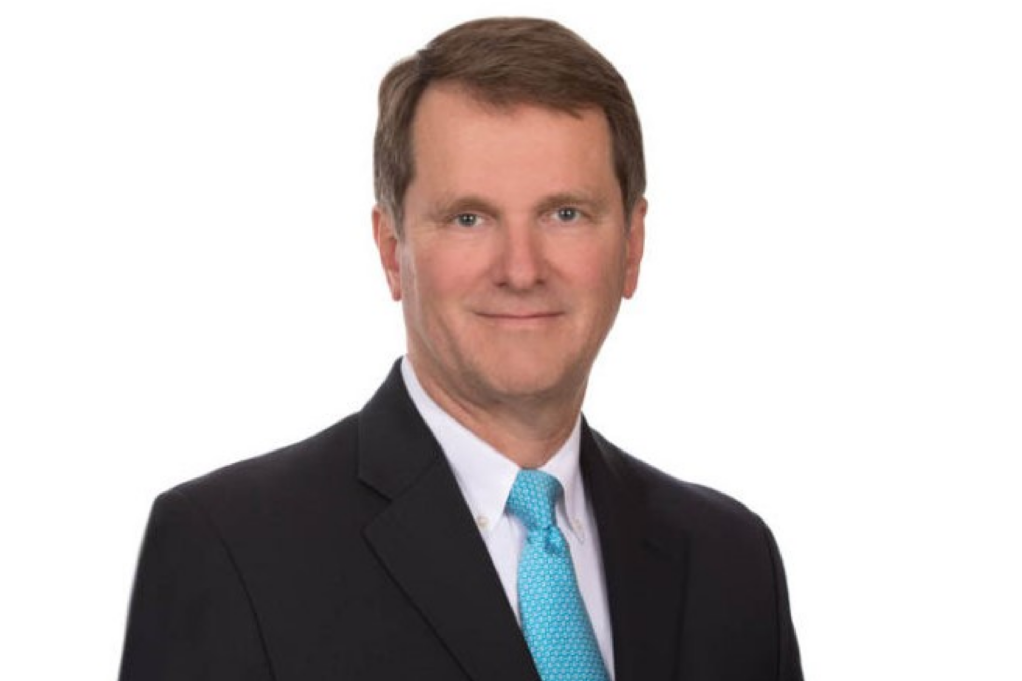
Rudy Ogburn
“Prior to Rudy joining our firm, Young Moore had several attorneys who dabbled in trusts and estates, but nobody who really grabbed it by the horns,” said longtime law partner David M. Duke. “Well, Rudy Ogburn took that practice area and he took it to a whole new level.
“I went down the letterhead the other day, and by my count no fewer than seven of our attorneys traced their origins directly to Rudy Ogburn. That, of course, is a lasting legacy that our firm enjoys and will continue to enjoy for many years to come.”
Ogburn, he added, held virtually every recognition a trusts and estates attorney could hold.
“If he wasn’t the very first, he was one of the first to be board-certified in Estate Planning and Probate Law,” Duke said. “He was a Fellow in the American College of Trusts & Estates Counsel, and was recognized in all of the peer-review publications every single year they were in existence.
“It is clear to me that Rudy’s professional accomplishments are yet another legacy of which most any other lawyer would be rightly proud. But Rudy wasn’t satisfied with professional achievement. Rudy was deeply committed to giving back through service to the bar, and to the community at large.”
By way of example, Duke noted that Ogburn had served as president of the Wake County Estate Planning Council, as chair of the NCBA Estate Planning & Fiduciary Law Section, as chair of the State Bar’s Estate Planning and Probate Law Specialization Committee, as president of the Jaycees, as chair of the Make-a-Wish Foundation of Eastern North Carolina, and as a member of the National Planned Giving Council of the American Cancer Society.
“The point that I am making,” Duke concluded, “is that Rudy’s legacy rests not with his professional accomplishments. To the contrary, Rudy’s true legacy rests with the manner in which he conducted himself and how he led a complete life, one that was punctuated with integrity, kindness, and decency, and he extended that to everyone with whom he encountered.”
Woody Connette, who serves as chair of the NCBF Development Committee, introduced the Anonymous Justice Fund.
“The Bar Foundation was founded in 1960,” Connette said, “and in the 62-year history of the Foundation this is a first – our very first anonymous Justice Fund – and I am honored to be here today to tell you a bit more about it. The donor has lived among us for decades. Now in their 70s, the donor wanted to pay tribute to future generations in gratitude for the benefits that the Bar Association and Bar Foundation have given to this individual throughout their career.”
“Anonymous,” as Connette referred to the donor, “had one of those ‘aha’ moments when they realized that lawyers could reduce their taxable Required Minimum Distribution from their IRA account by diverting it as a Qualified Charitable Distribution to the Bar Foundation.”
The donor, Connette continued, chose to remain anonymous so that others could learn from the way this gift had been made and to see themselves in the story.
“And just like this donor,” Connette said, “each of you would have this chance to support the Bar Foundation in a similar way. It’s an amazing opportunity for regular folks like you and me.”
“I have been encouraged to use my name,” the anonymous donor previously stated, “and someday I may, but right now I want to do this and hopefully catch the eye of people who look like me, because I am just like them. I am them.”
In the spirit of friendly competition, the anonymous donor has given permission to reveal their law school in order to denote that all five of the Justice Fund honorees featured in this article are graduates of Wake Forest University School of Law.
The preceding quotes from Joe Cheshire, Charles Mast, David Duke and Woody Connette were excerpted from their comments at the NCBF Dedication Ceremony on October 19, 2022. Additional coverage of the ceremony, including links to event photos and the complete video, is accessible here. Additional coverage of the Leo Daughtry Justice Fund is accessible here. Additional coverage of the first NCBF Anonymous Justice Fund is accessible here.
Russell Rawlings is director of external affairs and communications for the North Carolina Bar Association.