

Albert Diaz Becomes Chief Judge of Fourth Circuit Court of Appeals
Judge Albert Diaz of Charlotte became the 11th chief judge of the U.S. Court of Appeals for the Fourth Circuit on Sunday, July 9, when he succeeded Chief Judge Roger L. Gregory.
Diaz has served on the court since 2010 and assumes his new duties as the seniormost active member of the court under the age of 65, becoming the third judge from North Carolina and the first Hispanic judge to serve in this capacity.
A longtime member of the North Carolina Bar Association, Diaz has served on the NCBA Board of Governors and in 2017 was recognized as a Legal Legend of Color by the Minorities in the Profession Committee.
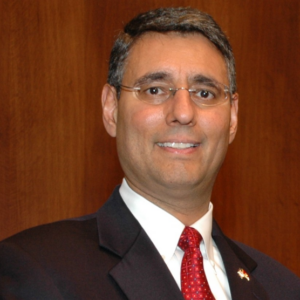
Judge Albert Diaz now serves as Chief Judge of the U.S. Circuit Court of Appeals.
“It’s funny, because when I talk to people about this and they congratulate me, I really appreciate it,” Diaz said. “But then I explain to them that there really isn’t any vetting process or scrutiny of my credentials. I just happened to be old enough and have been on the court long enough, but not quite too long, so it is kind of like Goldilocks, right? The porridge is just right, so here I am!
“The statute (28 U.S.C. § 45) for appointing Chiefs is a bit odd, but it seems to work in spite of itself. For whatever reason, the people who come to this work and are elevated to chief are committed and want to do the right thing, and they end up succeeding. I think a large part of that has to do with the staff that we are blessed to have in our court systems. The people who work for us are top notch and make us all look very good, so I am heartened by that. Judge Gregory is a hard act to follow, and frankly I am still trying to process it all, but I will do my best.”
Judge Gregory, who has served on the court since 2001 and will continue to serve as an active judge following seven years as chief judge, has already proven a valuable resource to his successor.
“We have talked throughout the year,” Diaz said, “and as it has gotten closer to the time when he would leave and I would take over, he has been very generous with his time. One never knows what is going to happen during their seven-year term as chief. Judge Gregory could not have known that covid would be the defining moment of his tenure. The way that he handled that was just amazing and outstanding in every way, and it allowed the court to continue to function and do the important work the courts do day in and day out under the most trying of circumstances.”
According to an announcement posted on the court’s website, “Judge Diaz assumes a variety of administrative responsibilities. In addition to hearing cases, he is the executive officer of the Fourth Circuit Court of Appeals and the Chair of the Judicial Council of the Fourth Circuit, which oversees the administration of the Court of Appeals, as well as the federal trial and bankruptcy courts in the Districts of Maryland, North Carolina, South Carolina, Virginia, and West Virginia. Chief Judge Diaz is also responsible for representing the Fourth Circuit in biannual meetings of the Judicial Conference of the United States, the judiciary’s national policy-making body.”
“Until you actually step into this job,” Diaz said, “you really don’t have the sense of the administrative responsibilities that come with it, and they’re just myriad. There are all kinds of things that you don’t think about when you’re a line judge because you don’t have to worry about that. But as I said, what makes it work is that we have career folks who allow the trains to run on time without delay.
“You are the chief executive officer for the entire circuit, but you can’t possibly manage the circuit alone. We have a circuit executive (James N. Ishida) who’s fantastic and serves as the day-to-day manager of the court. We will also soon have a new Clerk of Court, Nwamaka C. Anowi, who replaces our long-serving Clerk, Pat Connor. We will miss Pat dearly, but I have every confidence that Nwamaka will be a fabulous clerk. I will rely on James, Nwamaka, and the other leaders and staff of our court, as this is not a job that I could ever hope to do by myself. I need their support and their help, and I have it, so I am comforted by that.”
Diaz is one of three judges from North Carolina serving on the 15-member court. Judge James A. Wynn Jr. of Raleigh and Diaz were nominated by President Obama on Nov. 4, 2009, and appeared jointly before the Senate Judiciary Committee for their confirmation hearing on Dec. 16, 2009. Wynn was confirmed in August 2010 while Diaz was confirmed in December 2010.
Judge Allison J. Rushing of Asheville has served on the court since 2019.
“Judge Wynn and I have been pretty much connected at the hip throughout this process, and I still have the pictures from our confirmation hearing, so we go way back. And Judge Rushing has been nothing but wonderful to work with from the day she came on the court. Just the other day I called to ask her to serve on a committee, and she said yes without hesitation.”
Diaz also has valuable support in Charlotte, where longtime colleagues Frank Whitney and Robert Conrad have served as chief judges for the U.S. District Court for the Western District of North Carolina. “I have talked to them informally,” Diaz said, “and over the course of different conversations both of them have told me just how rewarding the work can actually be.”
Diaz is a native of Brooklyn with 25 years of combined service in the U.S. Marine Corps and Reserve, from which he retired in 2006 with the rank of Lieutenant Colonel. Over the course of his service, Diaz served as a prosecutor, defense counsel, appellate government counsel, appellate defense counsel, military trial judge, and appellate military judge.
Diaz earned a bachelor’s degree in economics from the Wharton School, University of Pennsylvania, in 1983, and graduated from the New York University School of Law in 1988. He also holds a master’s degree from Boston University. Diaz engaged in private practice with Hunton & Williams from 1988-95 and served as a Superior Court Judge and Special Superior Court Judge for Complex Business Cases from 2001-09.
The distinction of being the court’s first Hispanic chief judge, much like becoming the court’s first Hispanic judge in 2010, is something that Diaz acknowledges with humility and appreciation.
“Being the first Hispanic chief judge, and the third from North Carolina, those are pretty select clubs, and I recognize that,” Diaz said. “I do think that diversity continues to be an important goal and objective. Whatever one thinks of the recent Supreme Court decision on affirmative action, it doesn’t change the fact that we are a culturally, racially, and ethnically diverse country, and are all the better for it.
I am committed to promoting diversity in all forms, and remain cognizant that we are different, yet in many ways the same. It’s not lost on me that people look to me and others as role models, and I take that obligation very seriously and accept that, and will do my best with the help of others to ensure that the Circuit remains an inclusive and welcoming place to work.”
Russell Rawlings is director of external affairs and communications for the North Carolina Bar Association.