

‘Powerful Lineup of CLE Sessions’ Spans NCBA’s Founding and Future
On a February night in the Supreme Court of North Carolina, a group of men gathered to create a new organization for lawyers in NC. It was three months after the NC Democratic Party had returned to power in the 1898 election through a statewide white supremacist political campaign and the violent overthrowing of the multi-racial government in Wilmington. The new leaders and members who were present at the first meeting figured prominently in the political campaign, Wilmington Coup, and 1899 legislature that would enact the Jim Crow laws.
The agenda of that first meeting included the crafting of the organization’s constitution, and the intent was clear. It used white supremacist policies and ideas and expressly limited membership to “any white person.” This language limiting membership in the North Carolina Bar Association was not removed from the constitution until 1965.
Fast forward 124 years and a few months to the 2023 NCBA Annual Meeting in Wilmington, and a powerful lineup of CLE sessions highlighted the journey from the founding to the future. These sessions were birthed out of the powerful Report on the Relationship Between the NCBA and Systemic Racism, researched and authored by the NCBA’s Executive Director, Jason Hensley, and the follow-up report by the Task Force on Integration, Equity, and Equal Justice. Chaired by Rob Harrington of Robinson Bradshaw in Charlotte, the task force was filled with people committed to the advancement of equality and equal justice in North Carolina.
As the inaugural Director of Diversity at the NCBA/F, these two reports became my guidebook as I began to work on advancing diversity, equity, and inclusion in the organization. The work and leadership of Ted Edwards (chair of the Additional Steps working group), Russ Sizemore (chair of the Telling the Story working group), and Karlene Turrentine, (chair of the Contributions working group) gave me language, context, and motivation to weave the stories and experiences of those who were either unknown or forgotten to much of the membership. It was in studying these reports that we arrived at the three dynamic sessions that anchored the annual meeting.
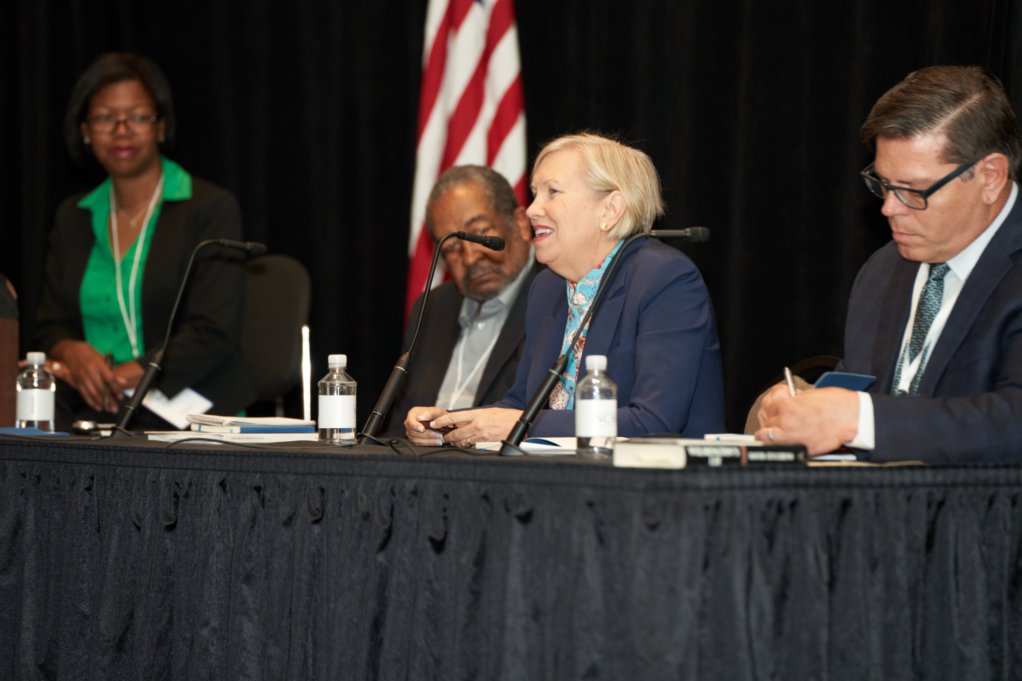
Dr. Donyell Roseboro (standing) moderated the opening panel that included, seated from left, Peter Grear, Lucy Inman and Richard Paschal.
“With this year marking the 125th anniversary of the 1898 coup d’état and massacre, and our annual meeting taking place right here in Wilmington,” Harrington stated in the opening introduction, “it is only fitting to focus our educational programming in ways that shine a light on an important part of both North Carolina’s legal history, NCBA’s history and the direct impact to generations of North Carolinians.”
Attorney Peter Grear, UNCW professor Dr. Donyell Roseboro, former NC Court of Appeals Judge Lucy Inman, and attorney-author Richard Paschal opened the sessions with Racist Roots: A History of the NCBA’s Founding, the Wilmington Race Massacre and Coup d’état, and Jim Crow, an in-depth table-setting discussion about the landscape of North Carolina in the latter half of the 19th century and the events that led up to the founding of the NCBA, including the 1898 Wilmington coup. It featured a powerful conversation between a Wilmington native, the great-granddaughter of Josephus Daniels, editor of the News & Observer, and two historians which came together for a thorough and compelling history lesson.
Paschal’s book, “Jim Crow in North Carolina: The Legislative Program from 1865 to 1920,” provided rich context for the conversation as the panelists delved into the extended and extensive impact of the Jim Crow laws on Black North Carolinians and the environment and circumstances that allowed them to be created. Dr. Roseboro closed the session with a reminder about the responsibility and power of lawyers in the public eye: “You all give me hope . . . in that you are doing this work. You’re thinking about not just the writing of the law but the application of the law and its entire impact.”
It was a truly profound start to the day.
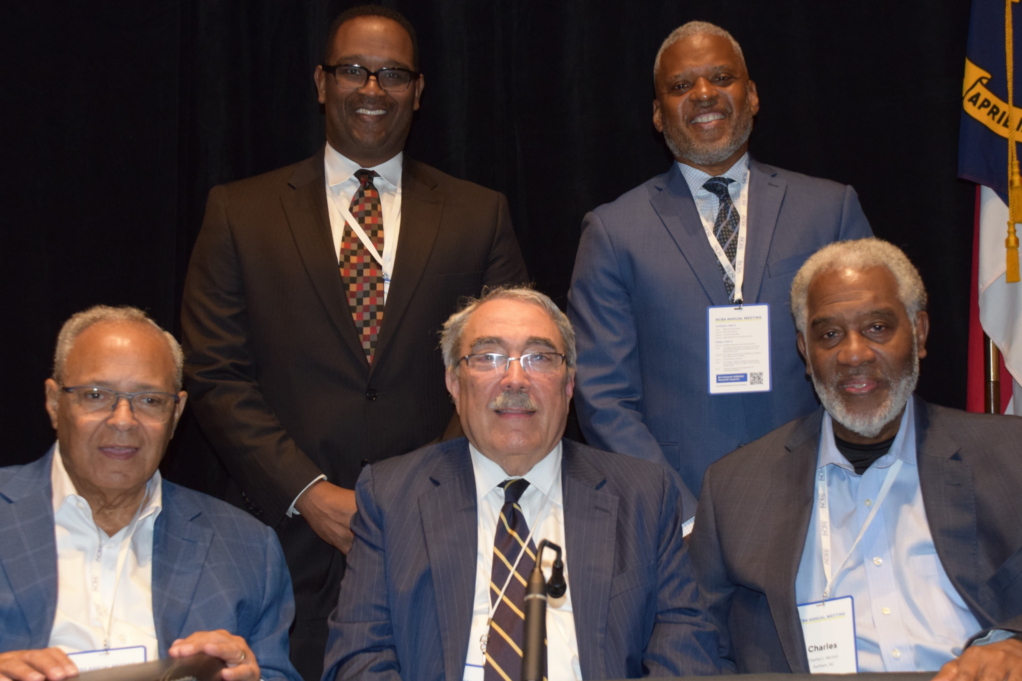
Ted Edwards (back left) introduced the second panel moderated by Ken Lewis (back right) that included, seated from left, Eric Michaux, G.K. Butterfield and Charles Becton.
Session two, NCBA in the Civil Rights Era: A Blend of Intransigence and Leadership, moderated by attorney Ken Lewis of Maynard Nexsen, was an unforgettable peek into the history and legacy of Black lawyers in NC. Attorney Eric Michaux, the man whose rejection from the NCBA in 1965 has been documented as a major impetus in removing the “any white person” language from the constitution, was joined by Judge Charles Becton, the first Black man to serve as president of the NCBA/F, and former U.S. Rep. G.K. Butterfield, a trailblazer in civil rights in NC. It was a masterful teaching on the lessons of the past and the giants that served this state without much mainstream recognition. Attendees certainly left that session changed by the information shared and the knowledge gained.
Michaux said this early in his remarks, “Early in my time, this meeting would have never occurred. There would have been an all-white face[s] crowd. Today, we have judges that have been on the Supreme Court, Superior Court judges . . . and even a president of this association. I saw none of this when I looked at the faces of my contemporaries when I applied for admission to this association.”
Becton, Butterfield, and Michaux challenged attendees, the Association, and the profession to be better. In talking about the early days of the NC Association of Black Lawyers to tales of the legal prowess and impact of Meredith Hugh Thompson, Conrad O. Pearson, and Fred J. Carnage just to name a few, the charge to move forward with inclusiveness and equality was clear. “Approach every issue in a way that includes rather than excludes,” Becton passionately stated. “If we right the wrongs of injustice, expose the poison of inequality, and ensure that all, even the least among us, have access to our courts, we will enhance the image of the profession while benefiting the communities in which we live.”

Taylor Dewberry (standing) moderated the Female African American Judges panel that included, from left, the Hons. Cheri Beasley, Carla Archie and Ashleigh Parker Dunston.
It was an opportunity for attendees that will not soon be forgotten but opened the door and ushered us into our last session, Realism, Resilience and the Future: Female African American Judges in North Carolina and the Future, moderated by Attorney Taylor Dewberry of Smith Anderson, and featuring former Chief Justice Cheri Beasley of the NC Supreme Court, Senior Resident Superior Court Judge Carla Archie of the 26th Judicial District, and District Court Judge Ashleigh Parker Dunston of the 10th Judicial District.
Collectively, they gave insightful and relatable wisdom about navigating the profession and the journey to the bench. Individually, they walked us through lessons learned, and the power of showing up in spaces and rooms authentically resonated throughout the room.
Judge Dunston said this in response to a question about how we show up: “I think that the biggest thing that we can do to allow ourselves to show up as authentic is to continue to educate. That’s why I appreciate the NCBA for having this event. This is exactly what’s happening right now . . . education and having the strength and the power to say ‘Listen, we’re going to have these hard conversations, we’re going to have these hard topics; we’re going to talk about what we talk about today, but we’re {going to} continue to talk about DEI efforts. We’re going to continue to talk about implicit biases. We’re going to continue to have these hard discussions, and we’re going to wiggle in our seats a little bit, and that’s okay.’ We’re going to take these discussions and take them back to our firms, take them back to our colleagues, take them back to our communities and figure out ways that we ourselves can impart to make the difference and to be the change that we want to see.”
There were several times when the panelists celebrated the newly installed dean of the North Carolina Central University School of Law, former Justice Patricia-Timmons Goodson, and what her presence and trailblazing time on the bench meant personally and as a powerful form of representation that impacted so many that followed her.
Judge Archie told a story from her early years on the bench where she wondered if she had received disrespectful behavior from a district attorney because of her newness to the bench, her race, or her sex. She then shared advice that Justice Timmons-Goodson gave upon hearing the story: “It doesn’t matter why,” Timmons-Goodson told her. “And any time and energy you spend trying to figure out ‘why’ is wasted time and wasted energy. Where you need to spend your time and energy is figuring out what your response is going to be.”
“And so, I’ve tried to carry that with me from day-to-day,” Judge Archie continued. “I don’t know why people do what they do. But I can regulate what my response is going to be. People will be mean; they will be disrespectful; they will be indignant and self-righteous. And I can [choose to] respond to that, but I can always regulate my response because I don’t know what’s motivating their action. They could be racist [or] they could be having a bad day. I don’t know. And I won’t say that I don’t care, but I have found that that is not energy well spent.”
As the panel wrapped up, there was a moment that sealed the day. Taylor Dewberry asked the judges about what they would like to see in the future regarding diversity, equity, and inclusion efforts, and former Chief Justice Beasley answered this way.
“I would just say to all of us, as lawyers, each of us chose this profession for a reason that’s probably not terribly different. And as we really think about the core of why we are lawyers,” Beasley said. “I would just urge that we not be so afraid to do what we’ve been called to do. I mean, none of us signed up for easy. And [with] every single case we take, every single litigant who comes before the court, there is a challenge. And it is usually not cut-and-dry or else we wouldn’t be needed. We are the guardians of the rule of law, and we are the ones who must fight for justice. Our clients, whether they are small businesses or people, depend on us for that. And it does mean that there are going to be times where there are issues that do arise that make us completely uncomfortable. But if lawyers don’t stand up for the rule of law . . . if lawyers don’t insist that courts be just and that there is justice in North Carolina and across this country, who will? If it’s not lawyers who will tackle the tough issues – if it’s not lawyers who will push the law – who will?
“We’ve been granted quite a privilege, and so it’s times like these, whether we agree or disagree, that we come together and really stand on our foundation as lawyers who not only founded this country, but for every single advancement that happens in our profession and in the rule of law, it is lawyers who push the boundaries. And I just hope that we always understand that even in our discomfort that we absolutely must stand in that and embrace it.”
The Annual Meeting took place during a particularly fraught time in the history of the NCBA as the Association navigated the fallout of the cancellation of the Sexual Orientation and Gender Identity Committee’s planned drag event in May. It was an incredibly difficult time for many of our members and highlighted the importance of diversity, equity, inclusion, and belonging in the work that we do.
The question of whether to carry on with these CLE sessions was asked many times in the weeks leading up to the Annual Meeting, and I believe was answered many times during those three hours. These sessions were not cure-alls or responses; instead, they were a powerful opportunity to remember, acknowledge, learn, and recognize. They were a reminder of the words of Robert Penn Warren, who said, “History cannot give us a program for the future, but it can give us a fuller understanding of ourselves, and of our common humanity, so that we can better face the future.”
There is work yet to be done and a great deal of opportunity to take the path that leads us to a more inclusive and equitable future.
Ebony Bryant is director of diversity & inclusion at the North Carolina Bar Association.