

10th Legal Legends of Color Awards Ceremony Held
The North Carolina Bar Association honored the 2025 Legal Legends of Color (LLOC) on Thursday, June 26, at the Renaissance Hotel in Asheville. The tenth annual LLOC Awards Celebration was a featured event of the NCBA Annual Meeting.
Presented by the Legal Legends of Color Subcommittee of the NCBA Minorities in the Profession Committee, the LLOC Awards “honor attorneys and other legal professionals of color whose legacies represent ceilings broken for all attorneys who follow in their footsteps and whose impacts on the legal profession are undeniable.”
This year’s recipients are Judge Loretta Copeland Biggs (retired), Judge Allyson K. Duncan (retired), Charles Edison Smith, and James E. Williams Jr. Their biographical sketches follow, along with excerpts from their acceptance remarks.
Video of the complete Legal Legends of Color Awards Celebration is also available.
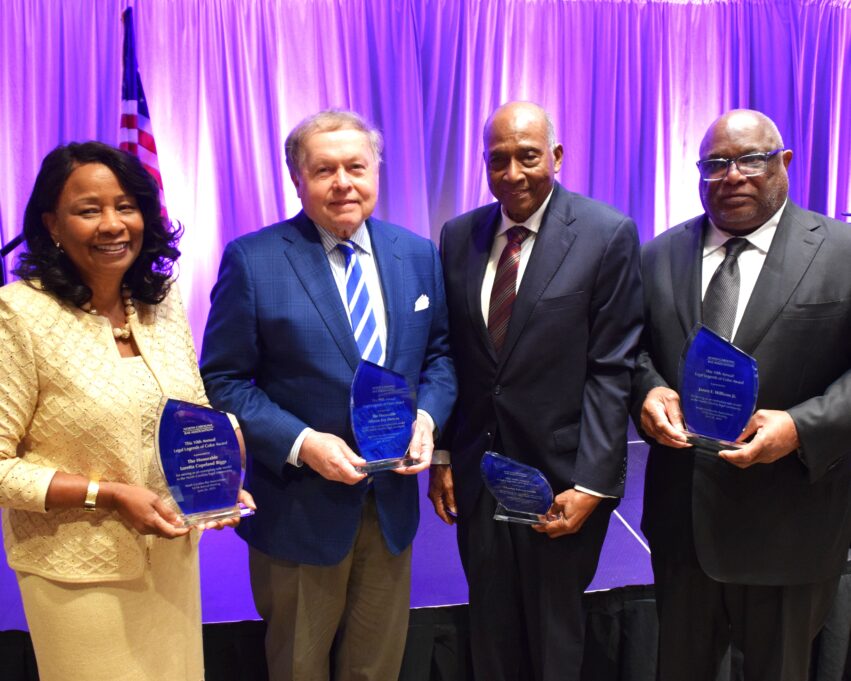
Legal Legends of Color dignitaries, from left, inductee Loretta Copeland Biggs, John Wester who accepted for Allyson Duncan, and inductees Charles Edison Smith and James E. Williams Jr.
Judge Loretta Copeland Biggs
Judge Biggs, who was introduced by Jeremy Locklear, obtained her bachelor’s degree from Spelman College and graduated from Howard University School of Law in 1979. She worked as a staff attorney for the Coca-Cola Co. for three years before moving to North Carolina to serve as an assistant district attorney in Forsyth County from 1984-87.
She was appointed by Gov. James Martin to serve as a District Court judge for the 21st Judicial District Court in 1987, and also began a three-year tenure as an adjunct professor at Wake Forest University School of Law. Biggs joined the U.S. Attorney’s Office for the Middle District of North Carolina in 1994 and became the Executive Assistant U.S. Attorney in 1997. She was appointed to the N.C. Court of Appeals by Gov. Jim Hunt in 2001, and served for almost two years before entering private practice. She worked with Davis, Harwell & Biggs until 2014 and briefly practiced with Allman, Spry, Davis, Leggett & Crumpler.
In September 2014, Biggs was nominated by President Barack Obama to serve as a U.S. District Judge for the U.S. District Court for the Middle District of North Carolina. On December 19, 2014, she became the first African American woman to serve as a judge on a federal district court in North Carolina. After ten years of faithful service on the federal bench, Judge Biggs assumed senior status on December 31, 2024.
Judge Biggs has dedicated over 40 years of her legal career to this state. She has taught and mentored so many, influencing a wealth of current and future North Carolina lawyers. Through the roles she has held and the difference she has made, she has exemplified the truest of commitment to her community and those around her. She has constantly shown up for both her community and a state that is fortunate to have her, blazing a trail for many coming behind her.
“I am so honored and thrilled to receive this award,” Judge Biggs said. “It means so very much to me. I’ve received a lot of awards in my life, but to get this award from this bar association – the state bar association – is very special. I am so proud to have had the opportunity to serve this state in the way that I was given the opportunity to do. This is not about me, and I don’t want to make it about me. It’s about opportunities for all of us to contribute to the state of our country, our nation, the world. I’ve seen a number of my young clerks here tonight. That’s what it’s all about. Our job, I tell them constantly now, our job is to mold them, to shape them, to help them understand the gifts, the wonderful gifts that they have, and how those gifts can be used to make things better for all of us. That is our mission.”
Judge Biggs, who assumed senior status in December, honored the occasion by announcing publicly for the first time that she is retiring from the bench.
“It’s important that we do understand that our journey – we’re on a journey – and that journey continues. I would give nothing for the journey that I have been on for now almost 45 years. It’s been an incredible journey. I hope that I have utilized the blessings that have been given me to help others. And that’s what I want our young people to think about. How do we use your gifts to help others that are coming along behind you? I will tell you, as a federal judge, the work has been demanding. It has been voluminous. But one of the most incredible experiences I have had is having some of the most incredible young people to clerk in my chambers. I’ve taken that as my one of my greatest missions – I try to ensure that I can help that young person be a stronger lawyer coming out of my chamber than coming in. And I pray that we’ve been able to accomplish that.”
Judge Allyson K. Duncan
Judge Duncan, who was introduced by Justice Anita Earls, served on the U.S. Court of Appeals for the Fourth Circuit from August 15, 2003, to July 31, 2019. She was confirmed by the U.S. Senate by unanimous vote of 93-0 on July 17, 2003, at which time she was also serving as president of the North Carolina Bar Association and Foundation. Duncan was the first African American to serve on the Fourth Circuit bench and the first African American – and only the third female attorney – to serve as president of the NCBA. She is a native of Durham and graduated from Hampton University (1972) and Duke University School of Law (1975).
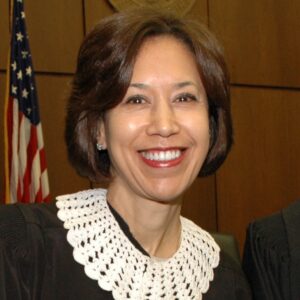
Following law school, Duncan served as an associate editor at the Lawyers Co-Operative Publishing Company (1976-77), as a law clerk to Judge Julia Cooper Mack of the District of Columbia Court of Appeals (1977-78), and held numerous positions with the Equal Employment Opportunity Commission from 1978-86. Returning to North Carolina, she served as an associate professor at North Carolina Central University School of Law (1986-90), judge on the N.C. Court of Appeals (1990), and commissioner of the N.C. Utilities Commission (1991-98). Duncan was a partner at Kilpatrick Stockton in Raleigh prior to becoming a Fourth Circuit judge.
Duncan’s impressive record of professional experience has been enhanced exponentially through her volunteer leadership, including but scarcely limited to her service as president of the Federal Judges Association and her appointment by Chief Justice John Roberts to the International Judicial Relations Committee, which she ultimately chaired. She also serves as a vice president on the Presidency Committee of the International Association of Judges as president of the Asian, North American and Oceanian Regional Group, as a board member of the Duke Endowment and International Institute of Justice Excellence, and speaks and writes frequently on rule of law issues throughout the world.
John R. Wester accepted the award on Judge Duncan’s behalf.
“Standing in for the Honorable Allyson Duncan of the United States Court of Appeals of the Fourth Circuit and a past president of the North Carolina Bar Association is an honor to cherish,” Wester said. “As I reflected on what I know of her for a good many years now, a poem by William Wordsworth came to mind, even though I’m confident that they have not met.
“William Wordsworth was disturbed by the advances of the Industrial Revolution and took refuge north of London for a good period, and wrote there several poems, including one that I expect most of you remember, “Lines Written a Few Miles above Tintern Abbey.” I believe he might as well have been thinking of Allyson Duncan when he wrote this. I have adjusted it for gender:
That best portion of a good person’s life, her nameless, unremembered acts of kindness and of love.
“As I share what I share with you this evening, I believe that it will bring home to you why what she has taken on and continues to take on cannot go nameless or unremembered. Were Allyson Duncan here this evening, she would provide you just the perfect words, with the perfect pitch and cadence. This room would light up, and what a joy it is to take in when she is on hand to light up your room.”
“Wherever she is this evening and whatever she is doing, rest assured that she is trying to help someone somewhere in some way, and will repeat that service tomorrow and tomorrow and the days thereafter. That must not go nameless or unremembered, even if it would just be fine with her if it did so. Hers is a motor that never stops running.
“She runs on wheels that remain in constant motion, for she knows not how to mail it in or go through the motions, or, I don’t believe, even how to coast. When she retired from the United States Court of Appeals after 16 years of service, she hasn’t even had much of a pause. Allyson Duncan is and remains a force of nature.”
Charles Edison Smith
Charles Smith, who was introduced by Lakisha Chichester, is a graduate of California State Polytechnic University (B.S., 1965), Georgetown University Law Center (J.D., 1972), and Duke University School of Law (LL.M., 1983), and also holds a master’s degree in industrial engineering from North Carolina A&T State University (2021). He is admitted to practice by the U.S. Patent Office, California, New York, the District of Columbia, and North Carolina. When he passed the U.S. patent bar exam in 1973, he became one of the first Black patent attorneys in the country; when he passed the North Carolina bar in 1987, he became the state’s first Black patent attorney. Remarkably, he is the most senior living Black patent attorney in North Carolina and is believed to hold that distinction in the nation as well.
Smith served as a patent examiner with the U.S. Patent Office before transitioning into
corporate legal practice, serving as counsel for Bechtel Corporation and as patent attorney for Xerox Corporation. He also worked as an attorney advisor for the U.S. Army Corps of Engineers and the U.S. Information Systems Command. He has devoted most of his career to legal education, first at Golden State University in California and beginning in 1979 with North Carolina Central University School of Law, where he initiated courses in patent law and other areas of intellectual property law, taught corporate and agency-partnership law, and serving as faculty advisor to the law school’s intellectual property law journal, which he helped found. He also served as associate dean, received the law school’s Professor of the Year Award, and co-founded the law school’s innovative Performance-Based Admissions Program (PBAP).
Professor Smith was the driving force behind the establishment of the NCCU Intellectual Property Law Institute in 2016 and served as its founding director. He practiced part-time with Olive & Olive in Durham for several years during his teaching career and rejoined the firm, of counsel, following his retirement from NCCU and continues to practice patent law.
“Here I stand,” Smith stated, “which was not a plan initially. I was allowed to venture to North Carolina for two to three years as a plan to establish a pipeline from an HBCU to the largest international engineering and construction company in the United States. Well, after the 40th year, I retired for the third or fourth time.
“It was a journey that I cherish and have been privileged to have been the mentor of those who became professionals – achievements beyond my ability to have provided them with, and they are looked upon throughout the world: as vice presidents, general counsels, deputy vice presidents, associate general counsels, judges, and the like. I am deeply grateful for having had the opportunity to just be in their lives and watch them grow in the law school and beyond.
“My journey beginning at the U.S. Patent and Trademark Office was a lonely one. I met who soon was to be a classmate at Georgetown Law School, Jerry Patterson, who was in a training program with General Electric. They would use the public search room, and he was the only Black one in the public search room, and I was the only Black one in my department at the U.S. Patent and Trademark Office. So we got together, and we did not make a pact, but we were determined that we were going to do something to make it so those who followed us would not experience the things that we experienced time and time again.
James E. Williams, Jr.
James Williams, who was introduced by Alecia Amoo, received a B.A. in Political Science and J.D. from Duke University. He was Chief Public Defender for Orange and Chatham counties from 1990-2017 and previously served as the Felony Chief of the Mecklenburg County Public Defender’s Office.
In 2010, while a member of the N.C. Advocates for Justice Board of Governors, Williams helped establish and served as chair of the Task Force on Racial and Ethnic Bias in the Criminal Justice System. In 2012, the work of the task force led to the establishment of the N.C. Commission on Racial and Ethnic Disparities in the Criminal Justice System, of which Williams served as a board member and later commission chair. He is also a founder and board member of the N.C. Public Defender Committee on Racial Equity and serves on numerous boards, including the N.C. Fines and Fees Coalition, National Consortium on Racial and Ethnic Fairness in the Courts, N.C. Association of Black Lawyers, and Orange Bias Free Policing Coalition. Since 2018, he has served of counsel at The Center for Death Penalty Litigation as Racial Equity Coordinator. In January 2020, Governor Cooper appointed him to the Martin Luther King Jr. Commission.
Williams has received numerous awards, including the N.C. Advocates for Justice Thurgood Marshall Award, the MLK University/Community Planning Inc. MLK Jr. Citizenship Award, the N.C. ACLU Champion of Justice Award, and the North Carolina Bar Association Constitutional Rights and Responsibilities Section’s James McNeil Smith Jr. Award. Most recently, he won the N.C. Advocates for Justice Annie Brown Kennedy Award for commitment to acquiring full freedom for all citizens of North Carolina and exceptional advocacy that protects individual liberties.
“This is indeed an honor,” Williams stated. “When I think about not just the honorees tonight, but those who have come in years past, it’s nice to be included in this group. Those people who know me know that history is very important to me. It should be to all of us, because history dictates so much of our current situation. I don’t know when I begin to comprehend that, but I certainly know it is so.”
Perhaps it was in his early teens, as noted in his introduction, when Williams attended a nonviolent civil disobedience training workshop hosted by the Southern Christian Leadership Conference. The keynote address was presented by civil rights attorney Floyd McKissick.
“I had just heard this powerful speech by a man that I found out later was a lawyer, and he was talking about the very things that needed to be done to address the things that the Klan stood for. And I had a sense at that time that I wanted to maybe do something like that with my life. I had a sense of the injustices within society, but I didn’t know what at that young age, what one could do. But I saw what Floyd was doing and, and that planted that seed.”
“I did become a public defender because I knew that there were people in need who needed services of the best. And I wanted it to be the best. That was my goal. I wanted them to have the same level of services that someone who had $500,000, who could go out and hire a lawyer, could get.”
Russell Rawlings is director of external affairs and communications for the North Carolina Bar Association.