

NC Hits a Home Run for High School Athletes – Todd Bowyer Sheds Light on Name, Image and Likeness Ruling

Todd Bowyer, photo courtesy of Poyner Spruill LLP
High school students in North Carolina now have a shot at profiting from their name, image and likeness. Before fall 2024, it was not possible to do so while they were in high school, but last year, everything changed. In October, high school athletes gained the ability to be compensated for the use of their name, image and likeness, thanks to a ruling by Judge A. Graham Shirley II. The ruling paved the way for high school students to begin earning compensation for their NIL. Judge Shirley II signed an order to grant a preliminary injunction in Brandon v. North Carolina State Board of Education.
Prior to the decision, in January 2024, high school students in private schools obtained the ability to profit from using their name, image or likeness, but this opportunity was not yet open to public school students. The 2024 ruling has leveled the playing field by making it possible for students at public schools to earn monetary compensation through promotions, sponsorships, and the like.
This issue is one that Todd Bowyer, an education law attorney at Poyner Spruill LLP, has written about in an NCBarBlog post emphasizing what schools, students and students’ families should know following the ruling.
Bowyer, who is a 2023 graduate of Elon Law School, has practiced as an attorney since 2024. He brings ten years of experience in higher education to his practice of law. Bowyer initially became interested in the legal field when he was working as the director of campus recreation for Roanoke College. There, as part of his role, he conducted Title IX investigations. One person he worked with, a former attorney, became Bowyer’s mentor. Through conversing with him, Bowyer began to think about going to law school and joining the field.
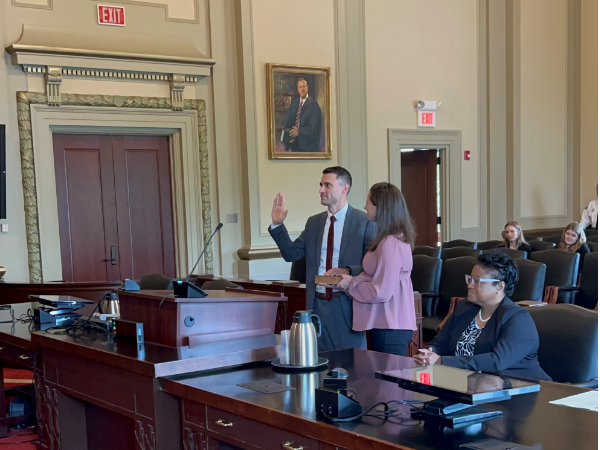
Bowyer, left, and his spouse, Jennifer, are photographed as he is sworn in. Keir Morton-Manley, Bowyer’s mentor, is seated on the right. This photo was taken during Bowyer’s swearing-in ceremony, held at the North Carolina Court of Appeals, May 15, 2024.
In 2021, after a brief stint working in student life at Ferrum College, Bowyer enrolled at Elon. At the time, he and his wife had one child; only two months after beginning law school, their second child was born. During his first year of law school, he signed up for the NCBA Young Lawyers Division Grab-a-Coffee Program, and was matched with Keir Morton-Manley, whom he continues to stay in touch with and learn from. Bowyer says that being a student participant in Grab-a-Coffee was a life-changing decision, one that led him to serve as an attorney volunteer for the program in 2024 and 2025.
In 2025, Bowyer joined the Education Law Section Council.
We spoke with Bowyer to hear his perspective on the name, image and likeness issue. How will it impact stakeholders, and what should schools, parents and students know? Learn more about the stakes involved in this issue, how his former experience shaped his interest in the field, and more in the interview below.
In your blog post, you wrote about the enjoining of the temporary rule, which provides high school students the opportunity to profit from their name, image and likeness (NIL). In March, the NCAA lifted the recruitment ban that prevented high school athletes from negotiating deals before entering college. These decisions make it possible for high school students to be compensated for advertisements, sponsorships, autographs and more, and the second decision opened up opportunities for high school athletes who plan on attending college. In what ways are these positive steps for student-athletes?
The name, image and likeness of anyone, but in this case, for student athletes, is fundamental to each person. To have the ability to not only control how your name, image, and likeness are utilized but to be able to earn compensation from it should really be available to anyone.
College athletes have been able to profit from their NIL since 2021. Since then, more than three dozen states have allowed high school athletes to do the same. Some high school athletes who were in states that do not allow NIL were moving out of state to take advantage of NIL opportunities in states that do allow it. North Carolina had a lot of back-and-forth over whether high school athletes would be able to profit from their NIL, but following the injunction and the adoption of the new State Board of Education rule allowing North Carolina’s high school students to profit from their NIL, the matter appears to be settled. So overall, I support the decision to allow high school athletes to profit from their name, image, and likeness as long as appropriate safeguards are in place.
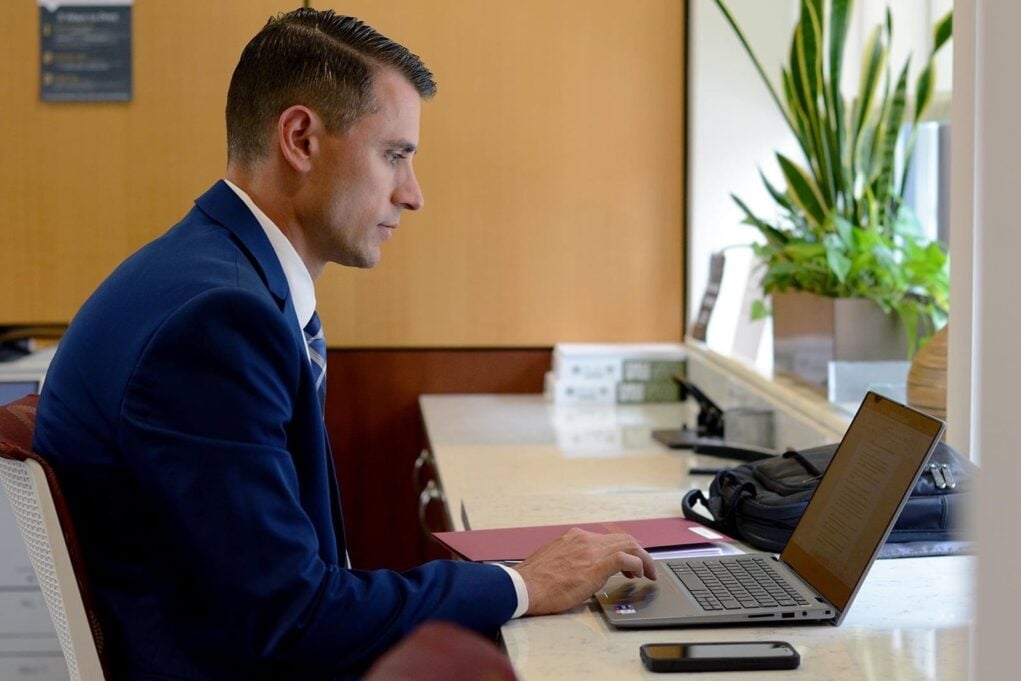
Bowyer photographed in the Cemala Foundation Commons at Elon University School of Law on the first day of his 1L year, August 2021. Photo courtesy of Elon University School of Law.
Considering the work that you do, could you say a little bit about how you anticipate these rulings to impact your practice?
We are training our school district clients on the rule and answering questions, and we have reviewed NIL agreements to make sure they are complying with the rule. I don’t anticipate NIL being a large part of my practice, but there are certainly challenges I think that school districts and student-athletes will encounter with NIL that may require the assistance of an attorney.
An area of concern that I expect to be a fairly common issue is timing. There are certain timelines for disclosure of these agreements and for completing the NIL course that’s offered through the National Federation of State High School Associations, the NFHS. At least 10 days prior to entering an NIL agreement, students – and their parents, if the student is a minor – must complete the NIL course through the NFHS, and they need to provide a copy of the course completion certificate and disclose the unexecuted, unsigned agreement for review by the school. Then, no later than five days after it’s executed, they need to provide a copy of the signed agreement to the school. After receiving the signed agreement, the school’s athletic director has to send a copy of the signed agreement to the administering organization. While the timelines are pretty clear in the rule, a student and their parents may forget to provide the unsigned copy of the agreement or fail to complete the NIL course until after they sign the agreement. So schools may want to consider making sure students and parents are aware of their obligations under the rule, too.
Another thing is that when I wrote the blog post, there was still uncertainty about some of the requirements that school districts and students needed to be aware of. For instance, the NCHSAA’s (North Carolina High School Athletic Association) NIL Certification of Compliance form does not specify whether the principal’s signature is simply an acknowledgement that the student and parent have certified compliance with the rule or if the principal is also certifying compliance.
However, the NCHSAA’s NIL checklist for use by schools does ask that schools confirm the agreement complies with the rule. So the checklist and the step-by-step process should help school administrators review these agreements, but there are questions on the checklist that may require attorney review. For instance, one of the items on the checklist is that the agreement complies with federal and state law, and there can be a lot to unpack there. School districts may need to consult their attorney to make sure that these agreements are in compliance with the law and with the rule on NIL. While my practice is largely in support of school districts as it relates to NIL, students and their parents may also want to have an attorney review an NIL agreement they plan to enter into.
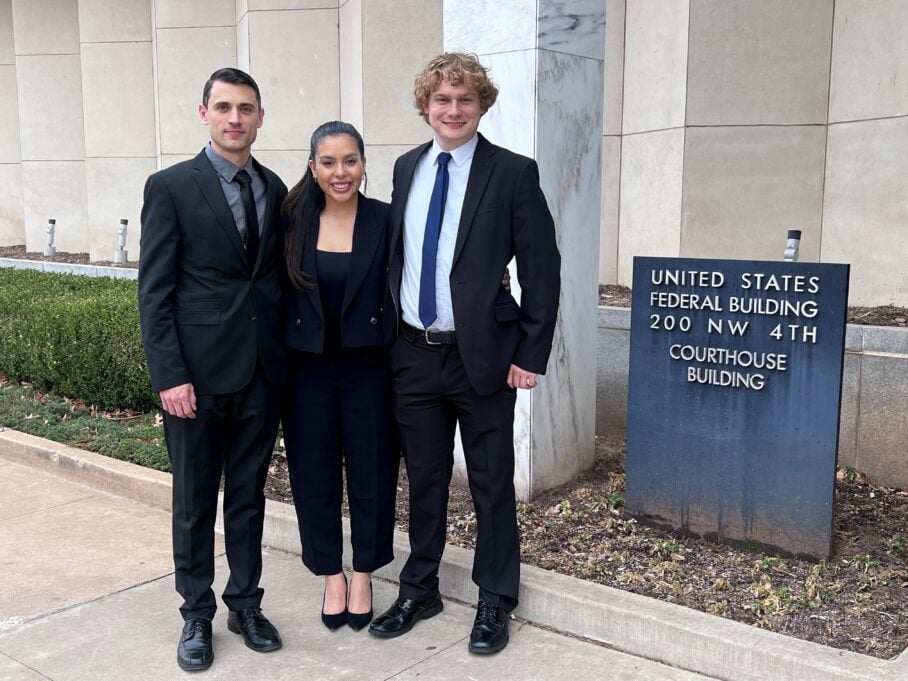
Left to right, Bowyer, Michelle Aguilar, and Alexander Long at the American Bar Association National Appellate Advocacy Competition, a regional competition held in Oklahoma City at the United States District Court of Oklahoma, February 2023.
Are there some grey areas related to these agreements?
Yeah, I would say there could be some gray areas. For example, student athletes can’t promote a product or a service or advertise for a company during an athletic competition or other school-based activities or events. But say prom season is approaching, and a student has entered into an NIL contract with a local store that rents tuxedos. And as part of the contract, the student agrees to wear a tux to school one day, which just happens to be the day of a pep rally. Is that prohibited by the rule? What if the pep rally is for a different sport? What if there was no pep rally and instead it was just a regular school day? I think there are some scenarios that school districts and student-athletes could get tripped up on.
From what you’ve described, benefiting from using one’s name, image and likeness can change a high school student’s life.
Most NIL agreements for high school students are not likely to be life-changing money. However, in the case enjoining the temporary rule and requiring the proposed rule be implemented immediately, that particular high school student-athlete had a lucrative NIL opportunity that he otherwise would not have been able to pursue. In sports, with the possibility for injuries and the inability to predict future success in college with certainty, there’s always a chance that a student-athlete’s career could be cut short due to injury or for any number of reasons. Having the ability to profit from their name, image and likeness while in high school, as the General Assembly apparently intended, can change someone’s life for those student-athletes with high marketability and earning potential.
Do you have any other thoughts that you’d like to share about the specifics of the NIL rulings?
Schools and student-athletes should remember that they have an ongoing obligation to comply with the rule. Students will enter into an NIL agreement, and everything is fine, but six months down the road when a student is getting paid to attend some kind of promotional event, and let’s say that they’re wearing their jersey to the event, which is prohibited by the rule, the student may be putting their athletics eligibility at risk. That’s just one scenario among many that student-athletes should keep in mind and schools should be aware of because an ineligible athlete can have repercussions on both the athlete and the school, too.
advertisement

What would the repercussions be if a student breaks one of the rules?
If a student breaks the rule, they could be found ineligible to play. If the student participates while ineligible, their team could have to forfeit the games in which that student played. Even if an ineligible student doesn’t play in a game and the team doesn’t have to forfeit, the team still might be playing without one of their key players. If playing against a tough team or a rival, maybe the team doesn’t win the game.
On another note, there’s also the recruiting issue. State Board of Education policy prohibits recruiting high school students to transfer from one school to another for the purpose of playing athletics. But there might be instances where there is a high school sports team that’s been really successful, and businesses have offered NIL opportunities to athletes on that team because those athletes are known in the community. A problem would arise if a school employee or a member of a school’s athletic booster club reaches out to recruit a student from another school and promises an NIL agreement if they were to transfer. That would violate the rule. The ban on recruiting is not new, but it could be more of an issue now that NIL opportunities are available to high school students.
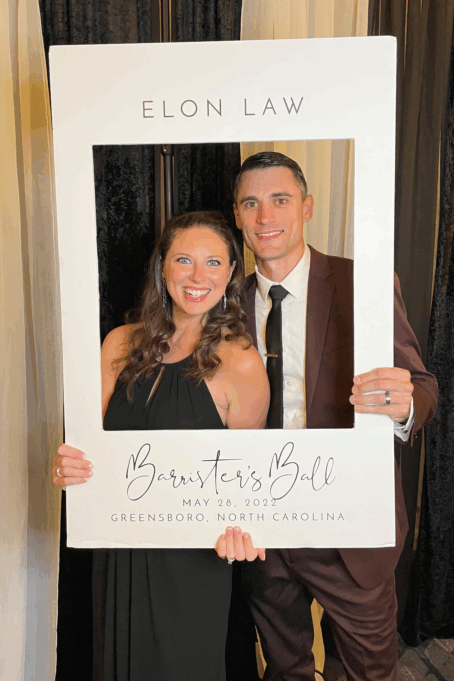
Bowyer, right, and spouse, Jennifer, pictured at Elon University School of Law’s Barrister’s Ball, held at Marriot Greensboro Downtown, May 2022.
You began at Elon Law in 2021, and you served as the Education Law Section Liaison from 2022 to 2023. You also served as a Notes and Comments editor for Elon Law Review. What did you find most rewarding about serving with the NCBA when you were in law school?
When I was a 1L at Elon Law, I signed up for the NCBA’s Grab-a-Coffee program, and that was the best decision I ever could have made. I was paired with Keir Morton-Manley, and she really helped me understand the legal landscape of education law in the state, not only with what’s going on in education law, but also the firms and attorneys with an education law practice.
When we connected when I was a 1L, she recommended that I attend the North Carolina Bar Association Education Law Section CLE that’s held in early April each year. Even though I didn’t need CLE at that time as a law student, I paid the registration fee and went anyway, understanding that it was an opportunity to learn about the latest developments in education law and to network with attorneys who were practicing the type of law I wanted to practice one day.
So I attended the CLE and later became the student liaison for the Section as a 2L. I was proud we were able to establish scholarships for law students to attend the CLE that year. So as a 2L, I wasn’t the only student there; I think there were five or so students who attended that CLE. It was great to see other students get involved. Having worked in student affairs in higher education, I’m passionate about student development and providing students with opportunities to learn about their areas of interest and to network. Being able to help facilitate the scholarships for the CLE was rewarding for me.
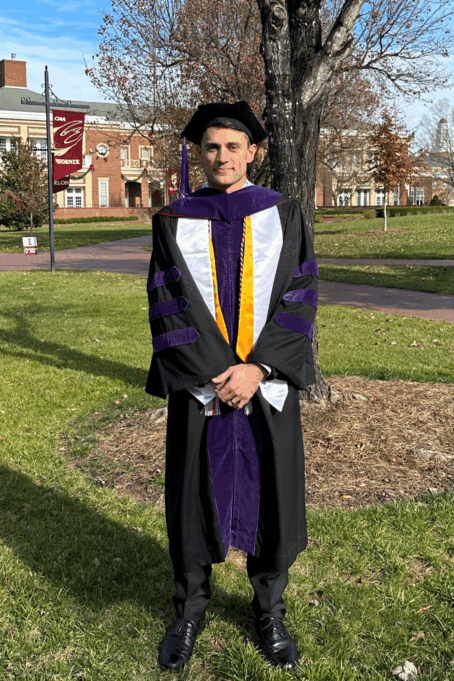
Bowyer pictured at Elon University’s main campus following the law school graduation ceremony, December 2023.
It is fantastic to hear how the Grab-a-Coffee program was helpful for you and continues to be because you’ve stayed in touch with your mentor.
She actually presented me to the Court of Appeals for swearing in after I found out I passed the bar exam and was approved for admission to the practice of law. It’s motivated me to serve as a mentor for the Grab-a-Coffee program myself, not just because of my background in higher education and student development and how much I enjoy working with students, but also due to the example she set by mentoring me.
When you entered law school, did you know that you wanted to pursue education law in particular, or was it something you discovered later on? I would like to hear more about how your experiences in education law may have shaped your interest in the legal field.
To give you a little more background, I come from a long line of educators. My dad was an elementary PE teacher. My mom was a classroom teacher for elementary and middle school, and then later in her career, she became a gifted resource teacher. My grandmother was a special education teacher’s aide. My step-grandmother was a high school teacher. When I was in high school, I thought I might become a PE teacher like my dad, but I gravitated more towards working with college students.
Although I did work as a substitute teacher in K-12 schools while attending grad school at James Madison University. I even had the opportunity to substitute for my dad. The kids were confused when I introduced myself as Mr. Bowyer, and I had to clarify that I was his son. I also had the opportunity to substitute for other teachers in his school, so it was special to work with my dad in that capacity.
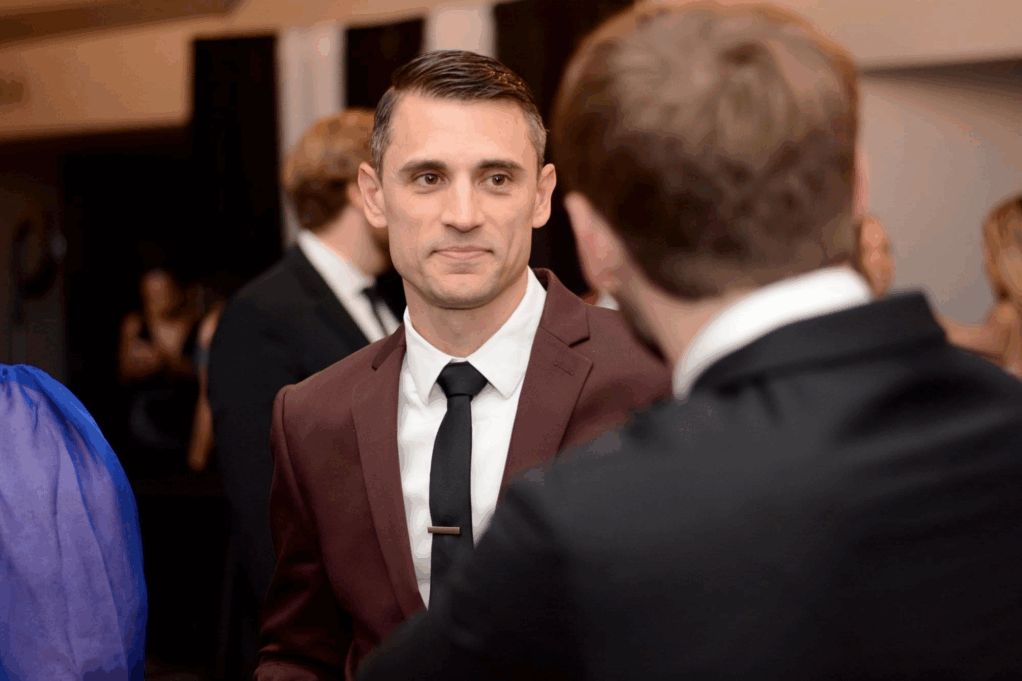
Bowyer pictured at Elon Law School’s Barrister’s Ball. Photo courtesy of Elon University School of Law.
During my career in higher education, my primary role was in campus recreation, but I also had responsibilities for on-campus Title IX investigations and student conduct cases. Those experiences, coupled with the fact that my supervisor, who was the Vice President for Student Affairs, had a J.D. and practiced law before going into education administration helped me develop an interest in going to law school and becoming an attorney with the intent to practice education law.
Coming from a family of educators and my prior career in higher education have given me a greater understanding of how educational institutions operate, their responsibilities, and the challenges faced by personnel at universities and colleges, as well as in K-12 schools and an understanding of the dynamics at play among students. I learned the value of public education early on, and I am grateful to be able to continue making an impact in the education setting.
Does your background in higher education make the name, image, and likeness issue especially important to you?
I think to some extent, because of my experience working with college students primarily in recreational sports. My department worked closely with the athletics department because we shared athletic facilities and had students who were not only participating on varsity teams but also working for or participating in Campus Recreation programs. Although ordinarily there may be fewer or less lucrative NIL opportunities for Division III athletes – or high school students, for that matter – than at the Division I level, I think my experience working with student-athletes who were representing their institution when they were on the field may have influenced my belief that they should be able to profit from their NIL off the field.
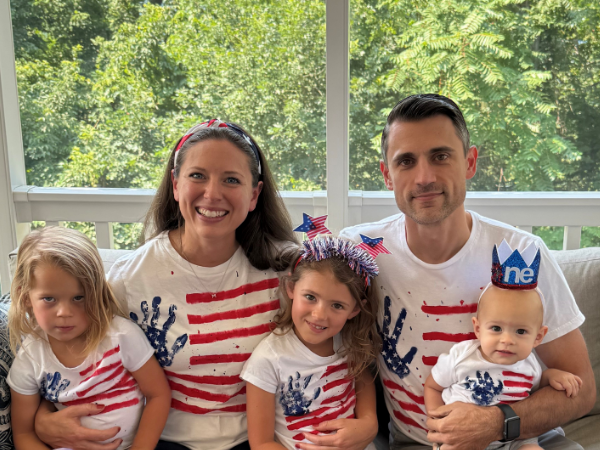
Bowyer and family celebrate their baby’s first birthday, July 4, 2025.
What did you find most challenging and most beneficial as a nontraditional law student? I would like to hear how your work and life experiences have offered a unique vantage point.
As a nontraditional law student, what was most beneficial to me was my prior career in education working with college students. Going to law school in my thirties was probably a little easier than it otherwise would have been because I had worked for years in a learning environment where students were going to class and pursuing a degree. They had papers to write; they had to study; they had exams. After being surrounded by students for so long, I think I was better prepared for the academic rigor of law school.
There were definitely some challenges though, including that many years had passed since I was a student myself. I was also married with one child and had another on the way. Our second child was born two months into law school, and we had our third child three months into law practice. Having the support of my wife was certainly another benefit. She would pick up the slack at home without complaint if I had a paper to write or an exam to study for.
What advice would you give to someone who is considering going to law school following some experience in a different career field?
Probably the first thing I would recommend is to consider if a career in law is what you want to do because law school and the practice of law are demanding and can have an effect on others. Depending on my class assignments – and now my caseload – at any given time, my wife often jokes, “I didn’t marry a lawyer.” So it’s important to understand how law school will fit into your life for those three years and how you will balance your other obligations and commitments. And then there’s the cost of law school. But law school is also interesting and intellectually stimulating, and the practice of law can be an incredibly rewarding career. If you have thought it through, and it’s the direction you want to take in life, and you are ready to make the commitment, just think of law school as an investment in your future. Before making the decision to go to law school, I recommend meeting with attorneys who are doing the work you think you might want to do to learn about their practice and maybe even work or intern in a law office. That could help an aspiring law student decide if going to law school is the right decision.
Personally, I had been thinking about law school since 2016, but I didn’t enroll until 2021. It was hard to give up a job and a salary, and I had my family to think of. I’m sure anyone thinking about going to law school has a lot to consider, but perhaps especially many nontraditional students. It may not always feel like the right time, but if you have made a thoughtful decision and you are committed to doing the work, at some point, you just have to take the leap.
Jessica Junqueira is communications manager for the North Carolina Bar Association.