

From Medical Planning to the Law — Meet U.S. Air Force Veteran and Attorney Leah Parady
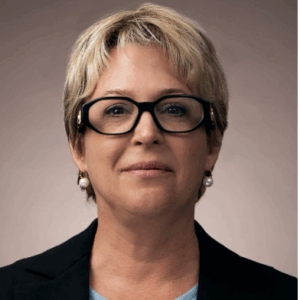
Leah Parady
Each November 11 offers an opportunity to honor veterans for their service, to reflect on their courage and to remember their sacrifices.
For 106 years, on November 11, current and former military personnel have been recognized. The day began as a commemoration of November 11, 1918, when the armistice between the Allied nations and Germany was enacted. One year later, in November 1919, President Woodrow Wilson proclaimed November 11 Armistice Day. In 1938, the day became a federal holiday, and in 1954, Congress amended the Act, so that the holiday recognized all veterans, regardless of which war they had served in.
This month, we spoke with NCBA member and United States Air Force veteran Leah Parady, an attorney with the Law Offices of James Scott Farrin, to shine a light on her military service and work as an attorney. Parady served in the Air Force for 18 years before going to law school and becoming a lawyer in 2021.
Prior to Parady’s military service, she was a member of the Reserve Officers’ Training Corps (ROTC) at the University of New Hampshire. While in the military, Parady focused primarily on medical planning. During her tenure, she traveled to forty-three countries, where she worked with groups of individuals to oversee medical planning for critical supplies in international locations. She also served as the U.S. liaison to NATO for medical planning later in her career.
In 2016, several years after her military career ended, Parady applied for law school and entered Campbell Law School in 2017. In April 2022, she was sworn in. She became accredited by Veterans Affairs (VA) to represent veterans seeking VA disability benefits. After earning this accreditation, she assisted family and friends and those who sought her out via word-of-mouth. In 2024, she joined James Scott Farrin (JSF) as an intake attorney.
In our interview below, Parady shares how she used her knowledge of medical operations to help individuals in various countries, what she has enjoyed the most about her roles in two different careers and how she leverages her military background as an attorney to make a positive difference in the lives of others.
What initially drew you to the field of medical planning with the United States Air Force?
I was a Medical Service Corps (MSC) officer, which translates to a hospital administrator in the military. I tried to spend as much time as possible outside the hospital setting, so I did a lot of atypical MSC jobs. I spent a lot of time in patient movement and emergency-management type roles and eventually became a combatant command planner. I worked with Air Force, Navy, Marines, Special Operations, and Army medical planners to coordinate and plan for contingencies. Planning included developing medical lay downs and determining logistical support, such as where to stage helicopters and planes needed to move patients, where to locate medical facilities, resupply channels — everything down to the amount of platelets and blood needed.
How many years were you involved in medical planning in the United States Air Force?
I was a combatant command planner for just shy of three years. And I spent most of my 18 years in these types of positions. For two and a half years, I taught the medical readiness block of the curriculum at the Air Force’s schoolhouse for new MSC officers and loved teaching. It was the equivalent of a master’s level training program, and the new MSC officers also learned about medical logistics, financing, computer systems, and managed care.

Parady, center, with the Slovenian Minister of Health, right, and a Dutch officer, left, while in Ljubljana, the capital of Slovenia.
Could you describe what you enjoyed the most about your work in medical planning?
Well, I traveled a lot, so that was probably my favorite piece of it. I also enjoyed meeting people from different countries. I was in Kyrgyzstan for one of my deployments. While there, one of the projects we worked was helping to build and outfit a new Kyrgyz military hospital in Bishkek, the capital of Kyrgyzstan.
There are a lot of logistical considerations when sourcing medical equipment because not everybody in the world provides care at the U.S. standard. You have to be very careful and considerate. For example, while it seems easy enough to buy and install new U.S. medical equipment, it raises a sustainability issue. There are electrical, maintenance, training and other considerations that, if not considered, may be prohibitive to keeping a treatment facility functional in the future.
That sounds difficult and like it involves many moving pieces and a big team.
It was, but it was a lot of fun. I deployed to Sarajevo, Bosnia, and Zagreb, Croatia, back in the late 90s, and this was my first interaction with NATO. I went to Bosnia as a junior NATO medical planner for patient movement. In that role, among other things, I met with Slovenia’s Minister of Health and negotiated the contribution of medical evaluation assets. While in Zagreb, I handled multi-national health care billing for treatment services rendered in Croatia to NATO troops.
Later in my career, while serving as the U.S. liaison to NATO for medical planning, I had a better appreciation for working with people from other countries. You learn to be appreciative, sensitive and tactful. One of the last exercises I oversaw from a medical planning perspective was in Tbilisi, the capital of Georgia.
What were some of the challenges that you encountered during these roles?
Travel was a wonderful component; it’s always challenging because it comes with logistics of getting from one place to another and sometimes missing flights. Another challenge was the language barrier — not only trying to communicate through interpreters in some cases, but more so learning NATO medical planning terminology and the international dynamics. For example, who was willing to treat who at what facility, what country’s patients could or could not be transported into Germany or other countries for higher levels of treatment, etc.

In 2017, you began law school at Campbell School of Law. What did you find engaging or fascinating about the legal field? Was it something that you had thought about early on?
I took some time off after I retired to get myself back into a good head space. Eventually, I did vocational rehabilitation through the Department of Veterans Affairs. It matched my two career fields: museum curator and attorney. I happened to be volunteering at the New Hampshire Museum of History doing a special cataloging project of antique quilts at that time; I enjoyed it because it was quiet but knew it wasn’t my next career. I finally decided to take the LSAT and apply for law school. To my surprise, I was accepted and moved back to North Carolina where I’d been stationed for many years to attend school.
Was there a previous point in your life where had you considered being an attorney?
I think everybody thinks about it, what they are going to be when they get older — an attorney, a doctor, all these formal fancy things. When I went into ROTC, I fell in love with military culture. Basically, I was willing to take whatever job they would let me go into, and I went in straight out of college, so being a legal officer wasn’t an option when I was first commissioned.
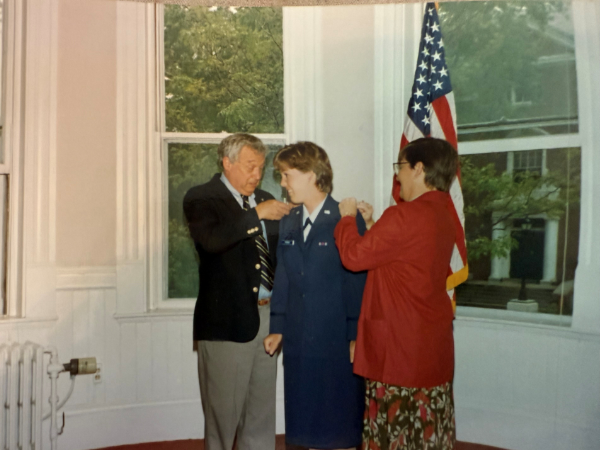
Parady, center, is commissioned as a second lieutenant in the U.S. Air Force as her father, left, and mother, right, pin on her first rank insignia.
What drew you into focusing on personal injury and workers compensation law?
I was helping family and friends with VA disability cases, but I didn’t advertise, and it wasn’t something I intended to do full time. One day I saw a position on Indeed for an intake attorney, and it sounded like an unusual position that may be a great fit. I learned that I’d be working for JSF during the initial interview. After being hired and having just over a year under my belt, I’d say that the intake attorney role combines education, sales and para-counseling — it’s likely not for everyone, but I really enjoy it.
In what ways does your background and experience in the military have an influence on your practice?
I handle initial calls with potential clients about personal injury, workers’ compensation and Social Security disability cases. My background in hospital administration, contingency response, and teaching have all proven beneficial.
While we don’t handle veteran’s disability benefits at James Scott Farrin, we have many disabled veteran callers particularly calling about Social Security disability benefits. The knowledge that comes from being a VA accredited attorney certainly helps when explaining the differences between the programs. It also allows me to gain electronic access to the veterans’ disability claims file with client consent; this provides a wealth of information that our team and the client couldn’t otherwise easily access.
Can you tell me more about what the process was like to become accredited by the VA to work with veterans at the beginning of your legal career?
The accreditation process is relatively straightforward; however, getting electronic access to veterans claims files takes time — there’s additional documentation requirements, a background check, and learning how to get access to the Veterans Benefits Management System (VBMS) takes some figuring out. However, not having access to VBMS, in my opinion, would be a disservice to the veteran client.
I still get the occasional call from a veteran via word-of-mouth or questions from veteran callers. No one’s supposed to charge veterans a fee for assistance with initial or increase claims; unfortunately, there are predatory services out there that do. I will always take a few minutes to provide guidance on these types of claims for this reason but refer all other claims.
What do you find most rewarding about the work that you do as an attorney?
I would say it’s helping people. My energy goes to talking to people all day, but there’s also a flurry of behind-the-scenes work involved. Putting someone into a relative place of comfort when they’re in a position of discomfort is rewarding. Whether we agree to render legal services or not, the goal is to build current and future clients so all communications are handled with care.
How has your community supported you throughout your various experiences?
I’m very close with my family, and my husband is very supportive. But I think everyone with prior service misses the sense of camaraderie that came with service. JSF provides a degree of camaraderie I wasn’t expecting — I work with a group of four other intake attorneys and a staff of intake representatives. I am surrounded by high-achieving, compassionate people who are simply good, supportive people. I couldn’t ask for a better team and feel fortunate to work at JSF.
It is wonderful to hear how you have leveraged your military service and experience and background to support veterans and people in your community. It’s very inspiring.
This is my second career. I haven’t been doing this very long, and I’m a relative new kid on the block. I always sought out the different and atypical jobs while in the military and arguably the intake attorney role is also atypical. I found my niche.
Jessica Junqueira is communications manager for the North Carolina Bar Association.