

Hannah Risser’s Roles in the Law and on the Stage
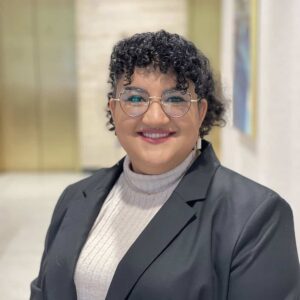
Hannah Risser
“All the world’s a stage, and all the men and women merely players,” writes Shakespeare in “As You Like It.”
These famous words remind us of how often we take on roles throughout our lives. While many of those roles differ from each other and may be separate in theory, one part can shape or inform other roles. Many possible roles are available to us, both professionally and personally. Playing various roles can spark new knowledge, energy and joy.
Since her early years, Hannah Risser, paralegal with Conrad Trosch & Kemmy, P.A., has played many roles in musical theater performances. She has performed in plays in her home city, Charlotte, and in Scotland, where she attended college. After developing her skills in musical theater and in backstage management, she has discovered that the stage she most enjoys professionally is the legal field. Along the way, she has realized how her love for the arts parallels her passion for her role as a paralegal.
In what ways does her community involvement energize and empower her career?
In reflecting on this idea, Risser finds it especially meaningful to be involved in communities where she thrives. A graduate of the University of St Andrews in Scotland and Central Piedmont Community College’s Paralegal Technology Program in Charlotte, she has grown in her career and in her life through two specific avenues: her North Carolina Bar Association involvement and her community theater volunteer work in the Queen City.
By serving with her NCBA community, Risser has built relationships with others in the profession and continues to discover more about the legal field. As a stage manager for local theater production companies such as Shepherd Shakespeare, she has supported the arts in her city and honed her organizational and teamwork abilities.
Risser, who has worked as a paralegal since 2019, is a member of the NCBA Paralegal Division and Minorities in the Profession Committee. When she became an NCBA member two years ago, she was eager to connect with and make a difference to others in the profession. Risser serves as the Communications Co-Chair and is on the Pro Bono and Service Projects section for the Minorities in the Profession Committee. She is active with the Paralegal Division’s Ethics Committee.
How does Risser leverage her talents to foster engagement with the paralegal community as well as the local arts community? In this interview, she provides insight into how her stages, both literal and metaphorical, have influenced her career and her life.
How have your experiences with the theater prepared you for your paralegal career?
Once per year, I work with Shepherd Shakespeare. It’s a Shakespeare company that two of my friends started, and they do a Shakespeare in the park event every year that’s free. It’s for families and kids, and they make it very accessible. They always do a comedy with a lot of physical jokes and things that the kids absolutely enjoy.
With that, what I do is help facilitate the rehearsals. I’m making sure that the actors are there on time. I primarily keep track of what the blocking is. Blocking is where the director tells the actors to enter, exit and move. It also covers who’s bringing on what props and who’s using specific set pieces. I keep track of all of that. And then if we get to a rehearsal and an actor says, “I forgot where I need to enter in the scene,” I have that information available.
A lot of what I do takes the administrative workload off the director so they can focus on just the creative side of it and decide what they want the actors to do. And it’s very similar to working as a paralegal because we’re trying to take as much as we can off of the attorney’s plate so they can focus on the substantive legal work that the paralegals can’t do. That allows attorneys to get more done.
As paralegals, we’re also saving clients’ money because we’re getting billed at a lower rate than many attorneys but can complete many tasks necessary for our clients’ cases. I definitely see paralegals and stage managers as similar because they’re both focused on organizational tasks and working to make sure that everything is running smoothly. When you’re a director or an attorney, you’re thinking about the big picture of the project, whether it’s a case getting ready for trial, or whether it’s a show that you’re trying to put on. It’s much easier to get that work done when you don’t have to worry about the nitty-gritty, and that’s what I end up doing.
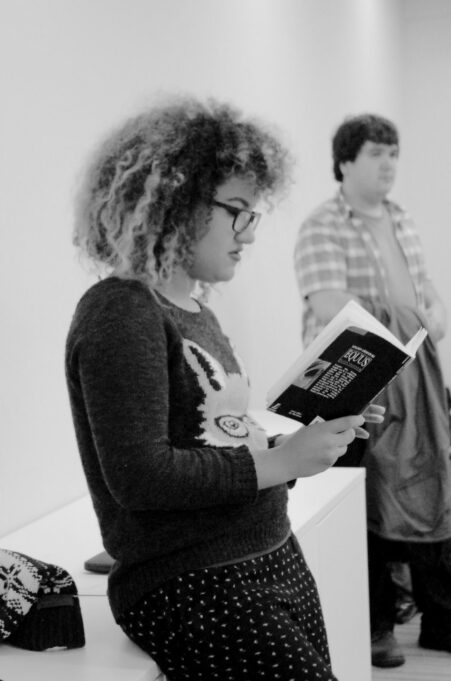
Risser served as a stage manager for a production of “Equus” at the University of St Andrews, 2016.
You studied musical theater in high school at Northwest School of the Arts in Charlotte and graduated in 2012. How were these early experiences significant to your life and to your interests?
I have always been a theater kid. My family is big into the arts. Once I moved to Charlotte, I found out there was an art school, and I said, OK, I have to go there. I majored in musical theater but also took classes in technical theatre, ballet, and costuming. The way that our classes were structured is that you had your core classes, of course, and then you had a certain number of arts classes that you took.
Through that, I discovered that I didn’t want that to be my career. I love it, but I decided this is going to be a hobby for me. When I left, I ended up going to school out of the country. I had always wanted to live somewhere else and move abroad. It just so happened that one of my friends in high school had applied to and gotten into the University of St Andrews. It hadn’t even occurred to me that I could apply to a college outside of the U.S. And I did, and I got in, and I said, OK, I’m going to go. (Can you see a theme here?)
I studied psychology there and spent a lot of time doing theater outside of my classes and was also involved in community outreach. I had a radio show, and I was doing dance class and archery. I’ve always been someone who wanted to be involved in a lot of different places.
After moving back to Charlotte, I began my coursework at CPCC and eventually gained employment at my first law firm. I became heavily involved in the local theatre community for many years, balancing work and rehearsals. Now that my workload has grown, I have less time to commit outside of work. I still do some theater in the community here. I’ve kind of cut down on the performing, but now I’m doing more backstage work, stage managing, that sort of thing. I always feel that stage managing is very similar to being a paralegal. It’s just a different field and venue. So those skills kind of transfer over to my hobbies as well as my work.
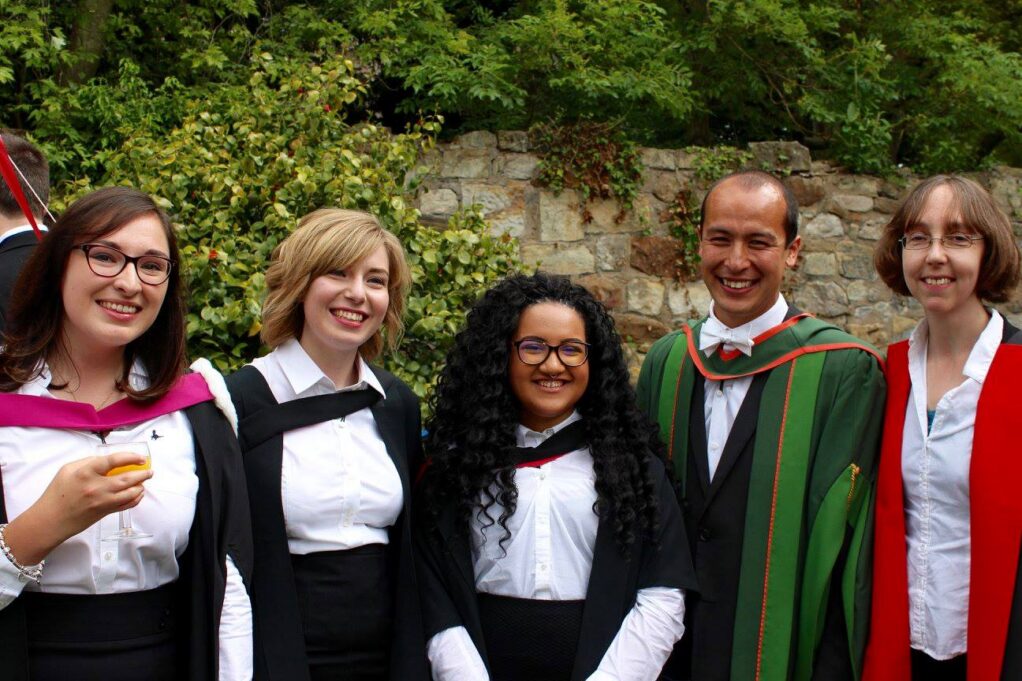
Risser, center, with Keziah Davison, Natalie Clark, Professor Akira O’Connor and Professor Gillian Brown at her graduation ceremony from the University of St Andrews, 2016.
In 2012, you moved to Scotland to attend graduate school for psychology at the University of St Andrews. What was it like to earn your college degree in Scotland?
The American college system is based on the Scottish college system, because in England, you receive your undergrad degree in three years. In Scotland, it’s a four-year program, but you graduate with a Master of Arts. You have to declare your major on your application. You start off working on whatever you are majoring in your first year. You have very limited credits outside of that to take other things. I took Russian and statistics, and I took a couple of history classes, but for the most part, all four years were spent on psychology.
Then, your final year is when you do your dissertation. You’re coming up with an experiment, you’re running it, and you are figuring out what statistical analysis you’re supposed to use to evaluate your information. Then, you write your 10,000-word dissertation. You have to orally defend it, and you also have to present it to a group of your peers.
That was a very involved project in my final year. I decided to do something along the lines of evolutionary psychology. I was looking at specific tests that we use to measure anxiety in rats. People would use this test to measure anxiety levels, especially with different stimuli. I was critiquing that test to show that it didn’t accurately measure anxiety and to show that it might not be as useful as they might think it could be. The work was pretty niche, but I think the best part was actually getting to play with rats for a month!
It was definitely hard and challenging to study there, especially because it’s such an international school, and you have people coming from all over, and everybody that’s going there has been the best at their schools. There’s a little bit of competition there.
advertisement

What did you find most life-changing about studying at the University of St Andrews?
Part of it was the independence because I went from being a teenager and living at home, and then moving thousands of miles away to a new country and not having the same support that other people might have if they were going to college closer to home or staying in an area that they were familiar with. I was lucky because my friend that I was in high school with, we went together. I had some support and a tie to back home.
Other than that, it very much was an opportunity to move quickly into adulthood and gain that sort of independence of figuring everything out on my own. The other thing that I liked a lot about it was the fact that it was a very international school. I was exposed to a lot of different people and a lot of different cultures, and everybody was always looking to share that sort of thing.
What led you to pursue a career as a paralegal?
Once I graduated with my degree, I was thinking about what career I wanted to have. I wasn’t really set on going for a Ph.D. I didn’t really want to go into a therapy setting, and I had gotten back into the theater community here. I was looking at what jobs I could do that would be flexible if I wanted to actually travel and do performing for certain contracts. I was interested in court reporting. Somehow, from there, I found out about paralegal work. I found out that there was a program here in Charlotte, and I decided, I’m going to do that. It sounded interesting — like something that I would enjoy and be good at.
It’s very similar to being a stage manager because it involves organization. You’re working with the attorney the same way you would be working with a director, making sure that the deadlines are met, the to-do lists are made and all of the bits and pieces of a project are moving forward the way that they should be. So I did the program at CPCC. I loved it.
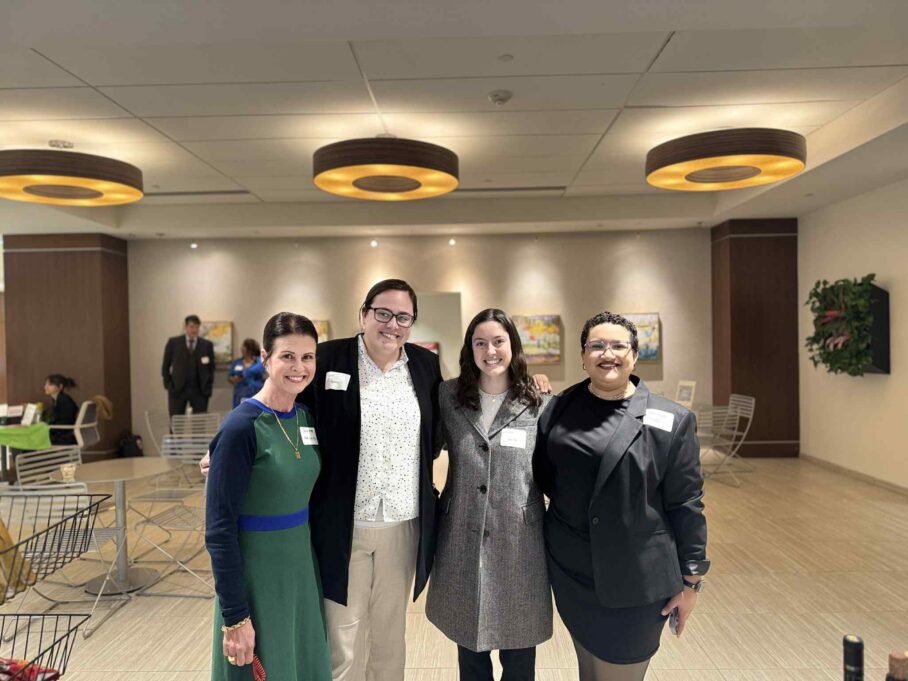
Risser, right, and co-workers Jennifer Arnold-Huff, Taylor Henry and Lauren Smith at an event at Conrad Trosch & Kemmy, 2025.
What mentors have had an impact on your professional development?
One of my instructors that I really enjoyed going to class with was Keith Shannon. He’s a former attorney and is now teaching at CPCC. He was great to work with. He’s a big theater fan as well, so we were always talking about that. He had a good influence on me and a lot of the other students because he made the information accessible and was a fun and charismatic person to be around.
We had a good number of paralegals at Marcellino and Tyson, and quite a few who had a lot of experience. That was also very beneficial because I have always told people that there’s a lot of information you can get from doing a program. But there’s so much that you can’t learn in the classroom because it’s just not going to come up as part of a curriculum. Having both pieces was really helpful for me because I learned so much when I was working there.
What are some of the highlights of your role with Conrad Trosch & Kemmy?
Part of it is just the history of the firm. It has been around for so long. It has this family element that is amazing. My attorney, Eric Trosch, is a partner, and one of his brothers is another partner here, and his other brother is a judge. My attorney’s wife is a judge. Their nephew is an attorney here, and their father is the one who started the firm.
We have this community feeling. Everybody gets along so well. The work that we get to do is interesting and varied. I don’t do the same thing every single day. With the caseload that we have, I really get to know the clients as well. That also helps us when it comes to representing them because they’re not just a name on the sheet or another number. We really get to know who they are and their history, and what’s going on with them now.

Risser, left, and fellow performers Alyssa White, Autumn Bolton and Sid Willoughby appeared in “Heathers,” 2023.
In what ways is it meaningful for you to be an NCBA member and to serve with the MIP Committee and Paralegal Division?
In general, being a part of the association keeps you more plugged into what’s going on. It helps you to stay connected to the community. It’s very easy to stay focused on your firm, your caseload, and then maybe a few things you might hear from other people at other firms. But with the NCBA, especially with the emails that are coming in, it helps you stay updated and hear what’s going on in the broader community, especially about events. It’s good to know what’s going on out there.
Then in terms of the specific committees that I’m in, I’ve really enjoyed seeing the kind of work that we can do. The MIP committee has so much great stuff going on, and I’m glad that I can be a part of the Communications Committee so that we can try to amplify the voices of legal professionals that are typically underrepresented. My co-chair and I have talked about different ways that we can highlight what’s going on in the MIP committee. We do our “Meet the MIP members” series, but we’ve also discussed sending out event wrap-ups to share the impact our work is having.
I also serve on the communications committee for the Ethics Section of the Paralegal Division. When it comes to my career, the CLEs are very beneficial. Then, the casual networking opportunities, when you meet a person and think, “It’s really cool what they’re doing.” I might help with this event that they want to do, or I’ve heard that they’re doing this kind of clinic, and I can share that with one of my clients because they might be interested in it. Everybody is doing all sorts of really good work, and I want to know what it is because I want to share it with everybody else so that people can take advantage of it.
In your experiences with community theater, what role have you enjoyed playing the most? Do you have a dream role you’d like to play?
I think the one that I’ve done that I had the most fun with was a few years ago, when I did Heathers. The movie Heathers was turned into a musical, and I played Heather Duke, so I got to do this whole mean girl routine. The movie and the show are set in the 80s, so we got to have big 80s hair and the crazy costumes, and that one was just so much fun to do. And then I think a dream role of mine would be Peggy from Hamilton. I think that would just be a really fun role to play.
What advice would you give to a new paralegal who is interested in getting involved with NCBA?
Start with the Paralegal Division. Look at the different committees there are, and then, think about what skills you have or what you’re interested in, and get in touch with the committees that align with that.
That would probably be the best thing because if it’s something that you already like, it’s a lot easier to integrate and get involved. Regardless of what you do, you’ll be fine, because everyone is very friendly and ready to help. Everybody wants more people to join their committees to make sure that the work gets moving forward. So even if you’re not sure which one to go into, just pick one, and you’ll be totally fine. What I’ve enjoyed most about being a part of the NCBA Committees are the people. Everyone is just so committed to the work they do, and they have a drive to improve the legal landscape that is inspiring. It makes you want to say, “Hey, I can get up, get involved, and make a difference too!”
Jessica Junqueira is communications manager for the North Carolina Bar Association.