

Inspiring Future Attorneys: Professor Nicole Ligon on First Amendment Law and Mentorship
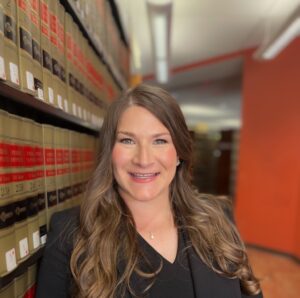
Nicole Ligon
To be vulnerable is to be courageous. Sharing your story involves pushing past any fears of letting others know you. When you are vulnerable, you open up space for others to know who you are, and you also create opportunities for them to be authentic in sharing their stories. Through learning about others, you have the chance to connect with them. As a result, you may make new friends and develop community as others learn about who you really are. When you share your experiences, you may have an impact on others’ lives.
Nicole Ligon, a professor at Campbell Law School, is impacting her students and the profession through her dedication to the field of constitutional law and to her values, and one of those is vulnerability. In a blog post Ligon penned this fall, The Myth of No Bad Days, she writes, “Maybe, when we’re honest about what’s hard, we make it a little easier for the next person to keep going, too.”
Ligon, who joined Campbell in 2022, teaches First Amendment law, trial advocacy, legal ethics, and other courses. She is a member of the NCBA Constitutional Law Section, and she also is a pro bono attorney with the National Women’s Law Center. Ligon conducts research related to First Amendment law, and has written on the compulsion of computer code by the government, the censorship of sexual assault survivors, anti-SLAPP statutes, and more. She has an article forthcoming in the March issue of the Penn State Law Review examining government press credentialing and the need for due process protections in decisions about journalist access.
She also is a mom to two young children.
Before joining Campbell, Ligon served as a clinical professor of law at Duke Law School and the supervising attorney of the First Amendment Clinic. She graduated from Duke Law School in 2016, after which she spent two years in New York City practicing media law.
Ligon decided to write her 2025 blog post to push back against the culture of perfectionism in the legal profession, where many people feel pressure to make it appear as though everything is always in order. She began to think about this idea while having a conversation with one of her students. In a course evaluation, the student wrote that Ligon seemed to have it all together.
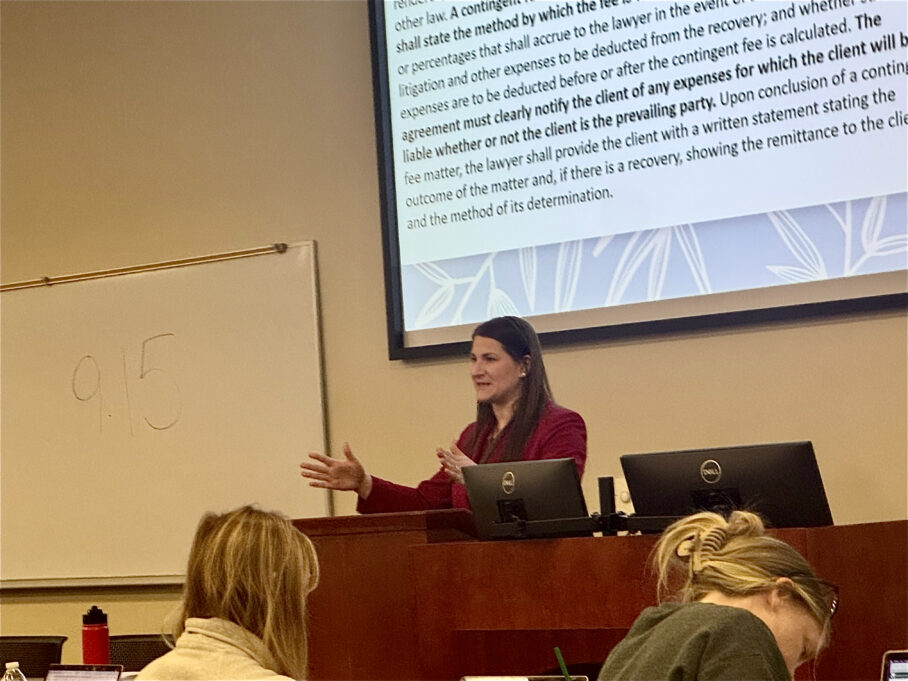
Ligon teaches Campbell Law students in her Professional Responsibility & Legal Ethics course, 2026.
When I spoke with her, Ligon expressed why it is important to counter this idea of perfectionism.
“Maybe we’re giving people unrealistic expectations that life can be perfect,” she said. “It can’t be perfect. It can be great. But it’s a lot better when we have colleagues and friends to rely on, and when the legal profession is a place where we support each other.”
In the blog post, Ligon writes that one can accomplish great things even while undergoing difficulties, loss and pain. Although it can be challenging to talk about those experiences, she hopes that her story will encourage others to be honest with themselves and one another about their weaknesses and their strengths, their losses and their joys. Speaking about those realities helps others to know they are not alone.
It also empowers people to achieve their goals despite difficulties they might be facing.
Ligon recalls a challenging season in her life that preceded, and ultimately led her, towards the law. She was majoring in Dance & Movement Studies at Emory University, and devoted much of her time to her dance team and performance groups.
Then, during her junior year, she unexpectedly contracted meningitis and encephalitis. Recovering from these illnesses took months. During that time, she could not dance. Because she had to take a break from physical activities, she began to reevaluate her major and college career.
As she was regaining strength, she didn’t have the physical energy to trek across campus to study, so she discovered a new place, perfect for reading and working on course assignments.
“I lived right next to the law school. I would just walk over and study in the law school library,” said Ligon.
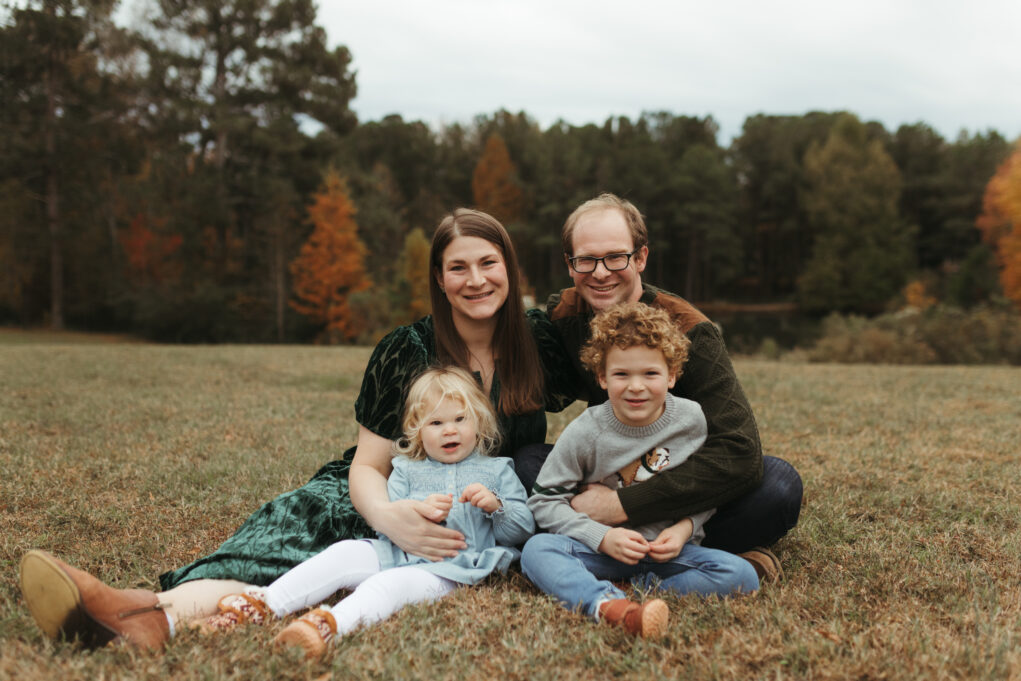
Ligon with her husband and children, 2025.
During one of those sessions in the library, she noticed a door with a sign that caught her eye. The sign read, “The Vulnerability and the Human Condition Project.” Whenever she walked by the door, she wondered what the project was.
Eventually, she decided to find out. She knocked on the door and met Martha Fineman, the professor who led the project. Fineman spoke with Ligon about her work and invited her to audit her classes at the law school — an opportunity Ligon readily accepted.
“I decided to apply to law school, in part, because I enjoyed my time working at the law school and learning about legal systems while auditing law classes during college,” she said. “Through those experiences, I met professors who encouraged me to apply to different schools based on my interests, including Duke.”
When Ligon began at Duke Law School in 2013, she brought with her some undergraduate exposure to legal coursework, but little firsthand familiarity with legal practice. Ligon’s father earned his GED and her mother attended a local college. Ligon was the first person in her family to attend law school.
As she explored different areas of the law, Ligon began thinking more deeply about the role media plays in shaping public life. A lifelong consumer of media, she came to see it as another form of art — one that, like dance, sparked a genuine intellectual curiosity.
Her interest was affirmed the summer after her first year of law school, when she took on a legal internship at the Lincoln Center for Performing Arts in New York City.
“There, I was able to connect legal principles with my longtime passion for the arts,” she said. “I loved watching dance performances online, but I had never really thought about who owns the rights to post a performance or the music that accompanies it. I had the opportunity to negotiate with domestic and international publishers for synchronization licenses and other rights-intensive agreements tied to media.”
Lincoln Center also had a robust pro bono program, with which Ligon worked closely that summer. One of the firms serving in that program was Cahill Gordon & Reindel LLP, with whom she completed a media law assignment tied to First Amendment considerations.
After graduating from Duke Law School, she moved to New York to work as an attorney with Cahill Gordon & Reindel.
“I have had incredible luck with mentors,” she said. “At Cahill, I worked closely with partner Joel Kurtzberg, and another formative mentor was Floyd Abrams. They trusted me with First Amendment cases early on, and that experience was foundational.”
At the firm, Ligon worked on a range of First Amendment matters, including representing freelance journalists in access disputes after their press credentials were revoked, as well as animal rights protesters challenging restrictions related to New York City’s horse carriage industry.
Two years into her tenure with the firm, Ligon returned to Duke to assist with associate recruiting. While there, she connected with Jeff Powell, a professor and former Principal Deputy Solicitor General of the United States. Duke had just received a grant to launch the First Amendment Clinic at the university, and Powell had been named its inaugural director.
Ligon reached out to Powell to see if they might meet during her visit. She was curious how she could support the clinic’s launch as an alumna working in the field.

“I shared that my firm handled a lot of pro bono work in the First Amendment space, but that we sometimes didn’t have the capacity to take on every case,” she said. “I wondered whether we might be able to send some matters the clinic’s way as it got up and running. Powell welcomed the idea and invited Ligon to meet for coffee.
Not long after, Powell shared with Ligon that he was hiring a clinical professor to teach alongside him, and he encouraged her to apply. In 2018, Ligon became the supervising attorney for Duke Law School’s First Amendment Clinic.
Powell is a mentor who continues to shape how Ligon thinks about the law and the profession.
“Jeff believing in me gave me a lot of confidence,” she said. “The first case I ever settled for the clinic was in Western North Carolina, and he trusted me to handle it on my own. I was 27. I still remember the moment we reached an agreement my client felt good about.”
After relaying the news to Powell, Ligon returned to her hotel room.
“I walked in and immediately threw up,” she said. “I was so stressed. Had I done it right? Why did it work this time? I didn’t want my students to see me having a moment. But my client was just so grateful, and to this day, I still feel proud of what we accomplished there.”
Powell is one of the mentors who inspired her to become the professor she is today.
“I wasn’t yet 30 when I started teaching a 45-person Media Law class at Duke,” she said. “I don’t think I would have believed I could do it if Jeff hadn’t shown me the ropes, believed in me, and encouraged me to publish, explore my research interests and eventually go on the academic market.”
As Ligon looks back on her career, one constant has remained. The relationships she has developed with others have informed her practice, provided her strength and deepened her gratitude.
“Something I love about law more generally is the relationships,” she said. “In North Carolina, I feel like the relationships you build last. And people show up in all different kinds of ways. My students graduate, and they become my colleagues and friends.”

Ligon, right, and Erin Kenny, professor of law at Campbell Law School, left, enjoyed taking a painting class in February 2026.
Conversations with peers have often sparked Ligon’s research and writing. She has published extensively on First Amendment issues, frequently drawing on real-world problems she encounters through practice and professional networks.
One such project grew out of a 2019 cyberattack targeting followers of the Epilepsy Foundation. During the cyberattack, thousands of people received flashing videos and images through their Twitter accounts.
Ligon learned about this issue through speaking with a fellow Cahill alum, Steven Lieberman, at the annual Media Law Resource Center conference. Lieberman was representing Kurt Eichenwald, a journalist, who was one of the individuals targeted by the cyberattacks.
“Some of Eichenwald’s posts on X, formerly Twitter, were controversial,” said Ligon. “Eichenwald suffered from photosensitive epilepsy. Someone sent him a private message containing a rapidly flashing GIF and the words, ‘You deserve a seizure for your post.’”
The message was designed to trigger a seizure, and it did. Eichenwald suffered multiple seizures and, despite taking medication, later fell into a coma over the holidays.
“Steve Lieberman was representing them in the civil case,” said Ligon. “He asked me, ‘You’re a First Amendment Clinic. Have you ever taken a position that narrows the First Amendment rather than expands it?’ I said, ‘Not yet, but I would for the right case. If the First Amendment is going to have real meaning, we have to be clear about where the boundaries are.’”
Ligon was asked to write an amicus brief for the case, and her clinic took on the project.
“We argued that this wasn’t speech — it was conduct, more like an assault. But even if a court treated it as speech, it would still fall outside the First Amendment’s protection.” Ligon said.
Her work on this matter prompted her to write an article called “Virtual Assault,” published in the University of Illinois Law Review. In it, she argues that messages intentionally designed to cause physical harm online — such as flashing images sent to trigger seizures, malicious interference with medical devices like pacemakers, or other technologies that can inflict injury remotely through sound or light — should not be treated as protected speech at all. Instead, she proposes recognizing a new legal category she calls “virtual assault,” contending that such conduct is more akin to a physical attack than expression and can be regulated without violating the First Amendment.

Jeff Powell, left, and Ligon, second from left, photographed before their oral argument at the U.S. District Court of South Carolina in Charleston, 2019. Ligon’s client is on her right. Her former student, Luke Smith Morgan, is third from the left.
Being able to research on issues related to the First Amendment, and to write and teach, is, in her own words, a dream job.
“I really love writing. It’s kind of like a puzzle. If there’s an issue I’m thinking about, it’s trying to piece it together. The “Virtual Assault” article grew directly from my practice because I’d worked on the case and seen how arguments played out in real life,” she said.
Many of Ligon’s projects emerge the same way; they are grounded in problems she encounters through her practice and professional networks.
She is equally passionate about investing in her students, just as mentors have poured into her.
“One thing I really enjoy is seeing people grow in their confidence,” she shared. “Seeing that growth is one of the most rewarding parts of teaching.”
In her trial advocacy course, she teaches students to try a full jury case. Many students begin the semester anxious about presenting in front of a courtroom, but Ligon has seen them develop the skills they need throughout the course.
“Watching that growth is incredible,” she said. “And it’s a testament to our whole team and the collaborative community at Campbell.”
For Ligon, her connection with her students doesn’t end at graduation. She keeps up with them long after they have taken her courses. Many of her students are now attorneys and parents. Other students have followed her lead to become professors.
One of those students is Luke Smith Morgan, who graduated from Duke Law School in 2019.
“Luke was in the very first cohort I ever taught,” she said. “I second-chaired him as he argued a case in federal district court in Charleston, and the judge offered him a clerkship on the spot. He was an incredible student, and we stayed in touch.”
When an opening at Campbell became available, Ligon contacted Luke, who applied for the position. Now, his office is next to hers.
That sense of connection extends beyond former students. Ligon is also grateful for her team of colleagues who support and encourage one another in everyday, often quiet ways. For example, she recalls when her children were sick, and it was going to be very difficult to teach her course that day. Professor Bobbi Jo Boyd offered to teach her class.
These small acts of generosity mean the world to her and reflect the culture she values most: one grounded in trust, mentorship, and showing up for one another. It is a testament to the amazing culture at Campbell and to a wonderful profession she loves.
“Sometimes, there’s this comfort in knowing other people are where you are. And we might look like we have it together, but we’re all going through it. You can lean on me, and I can lean on you. This sense of camaraderie, that we have of people looking out for each other, has meant so much to me. And I want to give that back.”
Jessica Junqueira is communications manager for the North Carolina Bar Association.