

Joshua Plummer — Two Worlds, One Calling
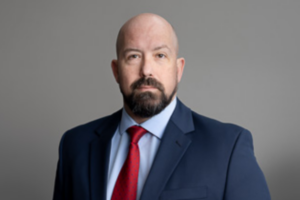
Joshua Plummer
Taking the road less traveled can make all the difference, says Robert Frost. There is a special significance in choosing the unfamiliar path. NCBA Member Joshua Plummer, a real property attorney, chose the military as his first career and the law as his second. What connects these two paths is one goal: serving others.
Plummer served for nearly sixteen years as a United States Marine before retiring early for medical reasons in 2019. While going through the medical retirement process, Plummer took the LSAT, applied to law school and opted to attend Wake Forest University School of Law following his retirement. He became an attorney in 2023 and practices law at Tuggle Duggins in Greensboro.
He has practiced for nearly three years, is a member of the NCBA Military & Veterans Law Council and is on the Board for The Reason Outdoors, a nonprofit that helps to bring veterans together through ecotherapy.
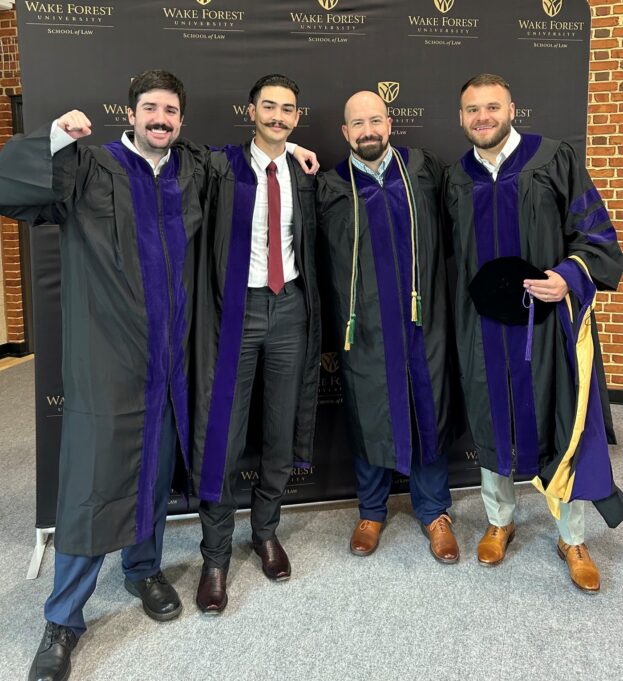
Plummer, third from left, and Tyler Spaugh, Kaleb Geisler-Zukaitis and Chris Carreiro are pictured following the law school graduation ceremony, May 2023.
When asked why he was drawn to the legal field as his second career, he listed two qualities about the law that resonated with him.
“Being in the military, I served my country. Being an attorney, you provide service to your clients. You’re always working for the benefit of somebody else. I think there’s an analogous component there. I think that was the decision behind law school. This is a career path that will allow me to grow, utilize some of the soft skills that I’ve learned in the military — writing, communication and analysis.
“You also have some autonomy as an attorney. When I retired, I had worked up to where I had quite a bit of autonomy. In my last deployment, I had 55 people that worked for me, so I’d worked my way to where I had some authority, some responsibility, and I enjoyed it.”
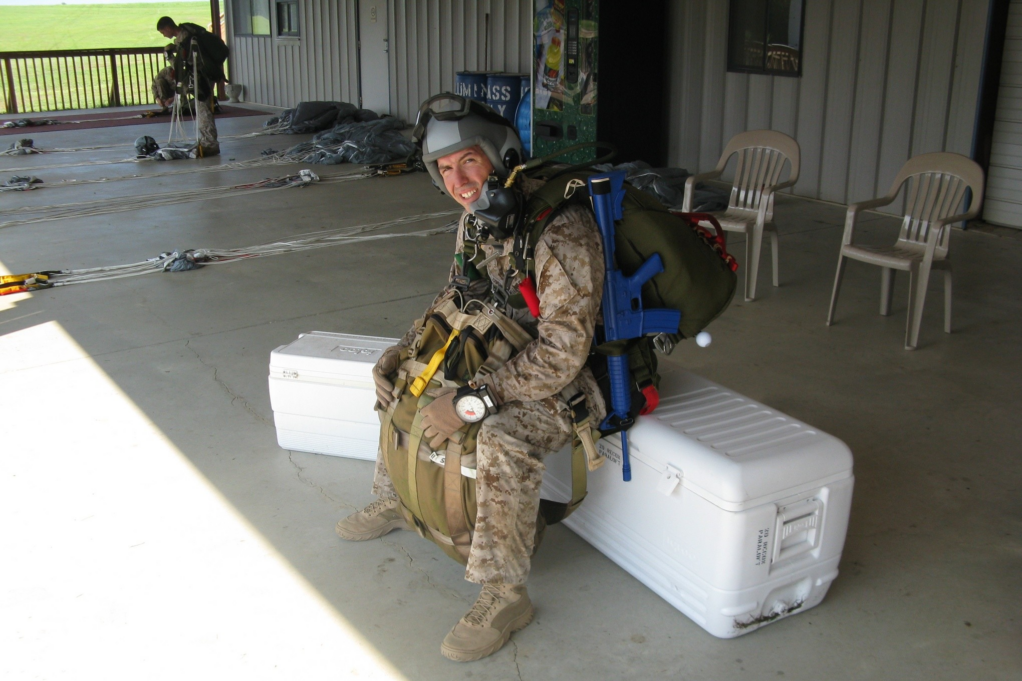
Plummer takes a break while waiting to engage in a training jump with Force Reconnaissance Company, II MEF in 2010.
While in the military, Plummer served in infantry leadership, intelligence operations and special operations. These positions provided opportunities to hone qualities important in his career as an attorney. He served in 2nd Battalion, 4th Marines, as an Infantry Platoon Commander and Company Executive Officer, and in 1st Battalion, 2nd Marines, as a Battalion Intelligence Officer and Company Commander. He was a Platoon Commander and Company Executive Officer in Force Reconnaissance Company (II MEF), an Intelligence Operations Officer for Joint Special Operations Command, a Regimental Intelligence Officer for the Eighth Marine Regiment and a Special Operations Training Company Commander at the Marine Raider Training Center. He was deployed seven times, including multiple deployments to Iraq and Afghanistan.
What are some of the greatest strengths he developed during his military career?
He mentions three specific capabilities.
“One thing I took for granted was the leadership development that the military gives you. I came in as a second lieutenant and had a 40-man infantry platoon that I was in charge of. They were all very young, but it’s all relative. You’re in charge, but you have a strong network of mentors around you. Then as I developed through my career, I took on more roles with either more people or more responsibility.
“The other piece that I think ties directly to the law is problem-solving. Everything in the military is geared towards some type of mission, and your mission may not always be the ultimate goal. Sometimes your mission is a smaller piece of a mission.
“For example, some folks have the logistics piece of a larger mission. You’ve got a piece as well, and at the end of the day, your mission may be a subset of a larger problem that all has to come together to experience success. It really teaches you to think about problem-solving differently. Something that’s very applicable to the law is, what does the real solution look like? Legal problems are often resolved by identifying and resolving a key subset of the larger problem rather than trying to solve everything.”
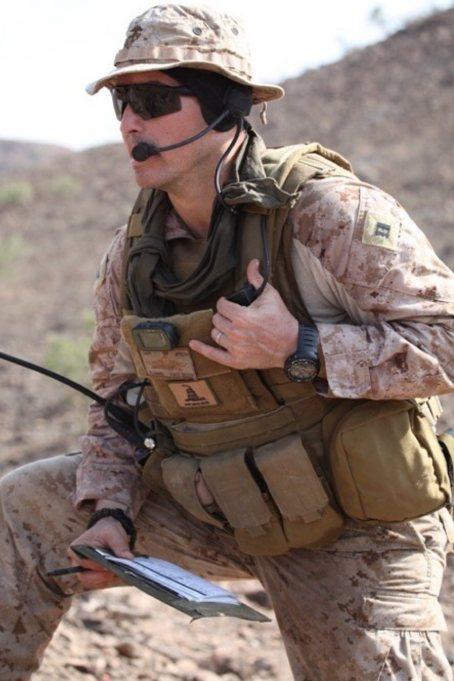
Plummer calls in an air strike during a training exercise while deployed in 2011.
Another trait he considers a core capability is relationship building. Throughout the years, he collaborated with others to achieve shared goals. At the same time, his leadership roles presented difficulties, which included making tough decisions while balancing competing demands.
“The other thing, too, is you really have to walk a fine line. In the military, there’s a strict chain of command. So being friends with the people you lead is not only tough, but dangerous. It’s the whole ‘Would you rather be respected than liked?’ I do feel like I kind of came out of it with both. I feel like most everybody I worked with respected me. I’m sure there’s a few that didn’t, and that’s okay. I looked out for them, and they looked out for me, so they recognized it, and that’s all that matters.”
Despite these varying tensions, he made friends, many of whom are in his life now.
“I have people that I worked with in the military from 10 and 15 years ago that I’m still good friends with to this day. I think that’s a sign that I must have done something right,” he said.
These friendships are a way for him to maintain a connection to that part of his life — a space that, in his words, feels like “a lifetime ago.”
In between his military role and his attorney role, he experienced some uncertainty about his future because a large part of his identity was tied to his work as a Marine. He hadn’t yet decided to go to law school, and he was considering what was next in his life. Although the emotions he experienced felt unique to him, he has spoken with other veterans who have also struggled while navigating from military to civilian life.
Moving to a new stage in life after serving in the military can be challenging for various reasons, but for Plummer, the overarching one was it was difficult to envision himself as something else.
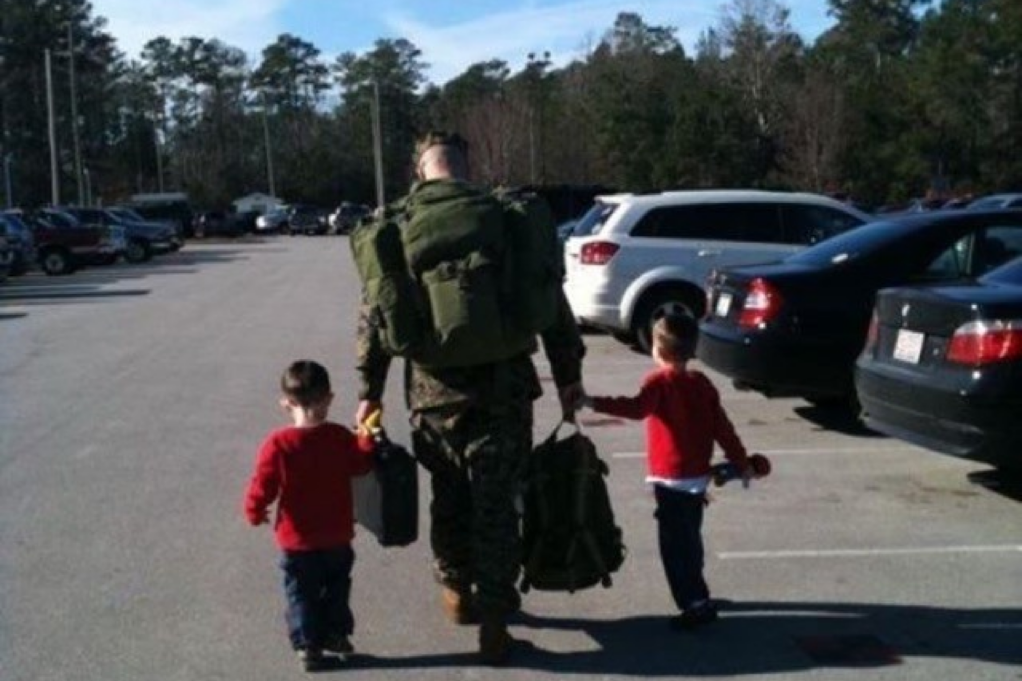
Plummer, center, and his sons walk to the car following his arrival home from deployment in 2012.
“I got lucky in that either I picked the right career or maybe I just picked one that’s busy enough that I don’t have time to think about struggling. But I do know there’s a lot of military folks that struggle with the transition. I feel very blessed that mine was somewhat smooth, that I found a path that works well for me and I think hopefully benefits others,” he said.
It’s clear to him now that this is the right role for him. But what led him to apply to law school?
“I knew that I had always wanted to further my education and take on a different challenge. I started kicking around the idea of going to law school. Wake Forest University was right here, but there were other options. I hadn’t really quite fleshed it out, and we were driving. I’ll never forget it. I don’t remember if we were dating or engaged at the time, but my now wife said, ‘Well, just shut up and take the LSAT.’”
That was the formative moment that started his path to becoming an attorney. When he got home, he signed up for an LSAT prep course, and in 2020, he began his first year at Wake Forest University School of Law.
During law school, he worked as a teaching assistant for Legal Writing and as a symposium editor for the Wake Forest Law Review. His talents were recognized: he received high grades in several courses, including the highest grade in Legal Writing II. One of the experiences that was especially meaningful for him was volunteering with the Veterans Legal Clinic. The Veterans Legal Clinic at Wake Forest gives law students the opportunity to use their skills to help former service members with less-than-honorable discharges seek discharge upgrades, often enabling them to gain access to veterans’ benefits.
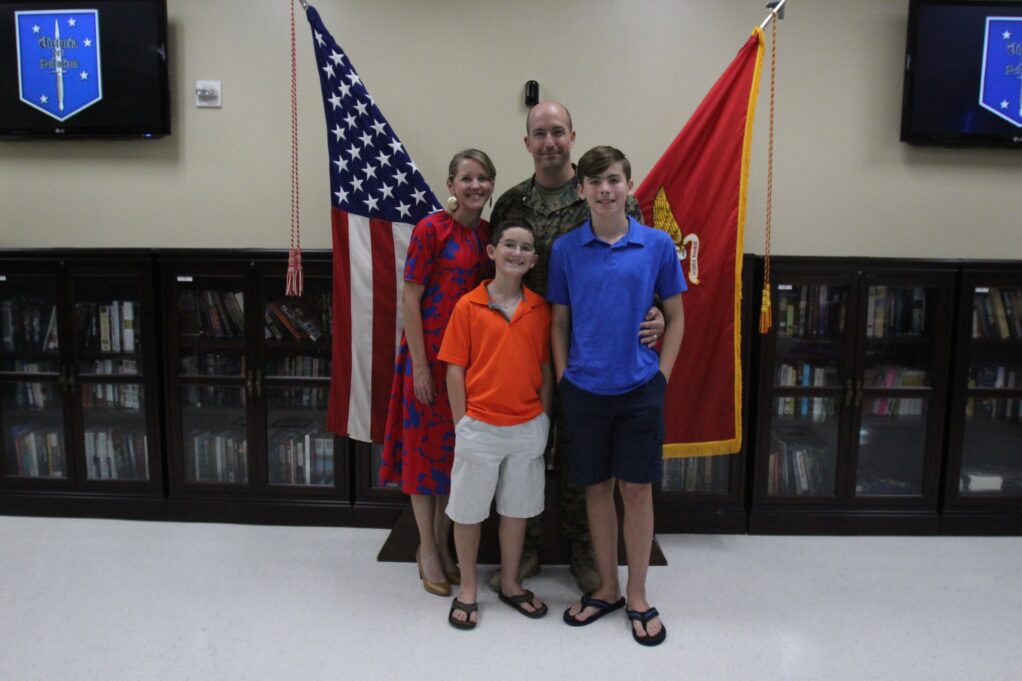
Plummer, center, wife Hannah, and sons at Plummer’s retirement from the United States Marine Corps in 2019.
During his second year in law school, Plummer wrote about what it was like to be positioned between his career as a Marine and his future role as an attorney. He describes it as if there were two parts of him. He likened this dichotomy to having two faces, each one distinct.
Discerning the difference between those two identities was important to him at that time. When I asked him if, four years later, he continues to see these two sides of himself as separate, he said he does.
“It is just as true now as it was then, probably more so, because it does dawn on me sometimes that I break the mold a little bit of what an attorney is. I think there’s things that I’ve done that nobody but other veterans have seen or done, and nobody else can understand that. Being an attorney is often the same way. It’s not just to come to terms with yourself, but it’s also just adapting in a healthy way or being able to cope healthily,” he said.
“Sometimes it’s necessary to compartmentalize those worlds, because those different worlds are not always compatible and if you don’t compartmentalize, it can be tough to find a healthy outlet or cope.”
Plummer is comfortable with these two parts of himself. He sees his military experience as invaluable, even if he views his attorney role as set apart from his former life.
advertisement

The part of him that has stayed the same across both roles is his commitment to helping others. When speaking of his commitment to his clients, Plummer shares that he deeply values the support he can offer to them.
“Client management is an underrated aspect of being an attorney, everything from managing expectations to managing emotions through the ups and downs and hardships. There’s a balance where you’ve got to try to keep clients positive and moving forward without overpromising.
“I have a saying that I adopted while I was in the military, and it kind of carried over — to under promise and over deliver. You don’t want to set the bar too high. You want to set expectations and be realistic and try to be optimistic but leave yourself room to over deliver.”
Client support is a significant part of his real estate attorney role, and it is also one of the facets that he values the most.
“I think the biggest reward is when you’re able to help a client get what they need or want. In most cases, our clients are business owners who are trying to close the deal, grow their business, start a business or something like that. They come to you because they’re trying to do something that they cannot do themselves. And a lot of times it’s complex,” he said.
“For me, probably some of the more rewarding matters that I’ve worked on have been some of the toughest, but not always the most prestigious. One in particular ended up being this long, drawn-out real estate deal that required negotiating with multiple second and third lien holders to take short sales. It seemed like every time we’d make a little progress, we’d run into another obstacle. And in the end, when the deal closed, there was a huge benefit to the client, and it was just the persistence to kind of keep moving through. It worked out for everybody.”
As he assists clients with various matters, there are ample opportunities to problem solve. This fits with one of the reasons he chose this practice area: its intricacy.
Compared to other areas of the law, he sees it as having a strong framework with a dash of mystery.
“Every area of law is a different puzzle. But for me, with real estate law, there are guardrails. It’s not quite as nebulous or amorphous as a lot of the other areas. If you’re a litigator, you’ve got this world of authority, and you’ve got to figure it out. Real estate law, it can get complex. But at the end of the day, it’s property, we’re all working together and terms are a little more defined. These deals are fairly structured. It feels a little more consistent and predictable with just the right amounts of unknown and complexity and challenge that still make it interesting and fun.”
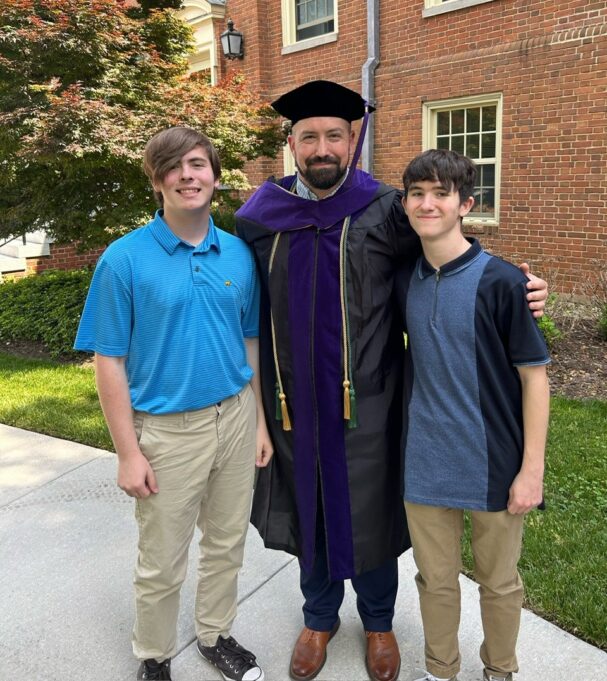
Plummer, center, and sons, at his graduation from Wake Forest University School of Law in May 2023.
Outside of his real property work, he enjoys volunteering. He serves on the board for The Reason Outdoors, a nonprofit that brings together veterans through trips focused on time spent in nature. One of the parts of the military he misses the most is the camaraderie, he says. The Reason Outdoors provides moments where veterans can connect with other veterans and cultivate friendships.
He says that people might not know how restorative it is to spend time in nature. It offers a peace that is powerful.
“Daily life tends to get very noisy. For veterans, it can be literally noisy, with tinnitus in your ears, the whole nine yards. But it’s amazing, when you get out in the woods, out in the mountains, out in the country with the silence, we kind of joke that the silence can make the noise stop. Being out there, that healing power of being there where you are, this little thing in the middle of nowhere, it really kind of changes your reality and makes all the other stuff drown away.”
Beyond The Reason Outdoors, he is involved in helping the legal community as a member of the Military & Veterans Law Section Council. He is grateful to work with other attorneys and with law schools to assist veterans across the state.
His engagement within the section has encouraged him to consider how he can use his attorney role to aid veterans in the future.
“I think every attorney likes or feels like they should give back in some way. It’s good to see how other attorneys in their practice give back to the veteran community. For me, I’m still trying to gain traction as a young associate. I am a VA-accredited attorney, which is good, but I’ve not really done much of that work because it’s kind of hard to balance. I’m still trying to get established, and I just transitioned between law firms.
“Down the road, I’d really like to take on some of those VA matters on a pro bono basis. Where I’m going with this is working with other attorneys in the Military & Veterans Law Section and seeing how other attorneys manage that with a goal towards trying that down the road and seeing where I can incorporate that as an element with the appropriate balance.
“But I hope that at some point, whether it’s through my involvement with The Reason Outdoors or veterans or through some extension of my practice, that I can bring that full circle to help other veterans in their transition. Even if it’s not the legal field, transition their lives as business owners or, maybe just use the nonprofit that I’m involved in with helping them kind of get out of a rut or maybe get on the right path. If I can give back in that way, I think that would be the ultimate goal.”
While it may not always be easy, choosing to make sacrifices for the greater good is a road worth traveling. It is one that Plummer has taken, and one that continues to influence the direction of his life.
Jessica Junqueira is communications manager for the North Carolina Bar Association.