

Right at Home in NC Health Care Law: A Q&A With Asheville Attorney Lauren Gennett
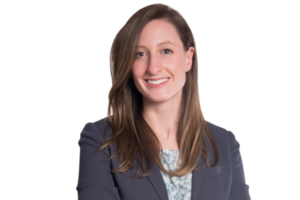
Lauren Gennett
Lauren Gennett, a healthcare attorney based in Asheville, has practiced law for over thirteen years with King & Spalding. Gennett regularly defends healthcare organizations in government enforcement matters, including investigations and False Claims Act litigation. She also has significant experience counseling clients on compliance program design and effectiveness strategies.
She serves on the NCBA Health Law Section council and as secretary, and she recently co-led a presentation on Government Enforcement and Compliance Developments as part of the section’s annual CLE program. In this interview, Gennett provides insight into her current practice, her involvement with NCBA and her passion for health law.
Gennett, who is from Ohio, moved to Chapel Hill to attend the University of North Carolina, where she became interested in the health law field through an internship with The Center for Adolescent Health & the Law. After graduating from UNC with a degree in public policy, Gennett attended Emory University, where she received her law degree and master’s in public health. She practiced law in Atlanta for nine years before relocating to Asheville in 2022.
Through her experiences in college, including her certification to become an Emergency Medical Technician, Gennett was inspired to travel to West Africa on a volunteer trip. Her experience led her to co-found MedPLUS Connect, a nonprofit that helps hospitals in developing countries to receive recovered medical supplies.
After returning to North Carolina, Gennett expanded her involvement with NCBA by serving as CLE Committee co-chair.
You graduated from UNC, and you received your law degree and master’s degree in public health from Emory University. What led you back to North Carolina?
I joined the King & Spalding healthcare team in Atlanta in 2013, and I’ve been fortunate to have been with the firm for my whole legal career. Atlanta is a great city, and it was a fantastic place to begin my legal career. My husband is from Asheville, North Carolina and we moved back in 2022 so our two young girls could grow up closer to family. I’m grateful to be able to continue working with the healthcare team at King & Spalding doing the work I love but also living in a place that is so special to me.
In your role as a health law attorney, you advise clients, including hospitals, and help them to prevent and manage risk. What are some of the most rewarding aspects of your practice?
The most rewarding part of my practice is that I am able to support my clients in providing much-needed healthcare services or providing products that enhance the provision of care. I see firsthand how hard my clients are working to provide excellent care to patients or to offer creative technical support and solutions. I am honored that I am able to have a part in enabling providers to serve their communities and follow their mission.
How did you become interested in the legal field?
I come from a family of attorneys, but I did not grow up thinking I wanted to be a lawyer. My grandfather Richard Weinmann was a labor lawyer in New York City, and both of my parents practiced family law in my hometown of Cleveland, Ohio. In high school and college, I became interested in healthcare, and I started college at the University of North Carolina Chapel Hill on the pre-med track. To obtain some hands-on experience while in college, I became certified an EMT. That was a very helpful step for me because I learned that the sight of blood made me ill! At the same time, I was involved in some great healthcare-related volunteer programs at UNC which broadened my perspectives about all of the facets of the healthcare industry. It was illuminating for me to realize that there are many ways that you can be involved in the healthcare space and be supporting the clinicians on the ground, even if you’re not necessarily the one providing direct patient care.
Needing to pivot my career path but wanting to stay involved in the healthcare field, I ended up majoring in public policy with a minor in social and economic justice. After college, I was excited to pursue both public health and law, so I decided to attend Emory University because the school offers a joint J.D. and MPH program. As an added bonus, Atlanta has so much to offer in the healthcare field, including the Centers for Disease Control and Prevention, where I was able to work part-time during graduate school.
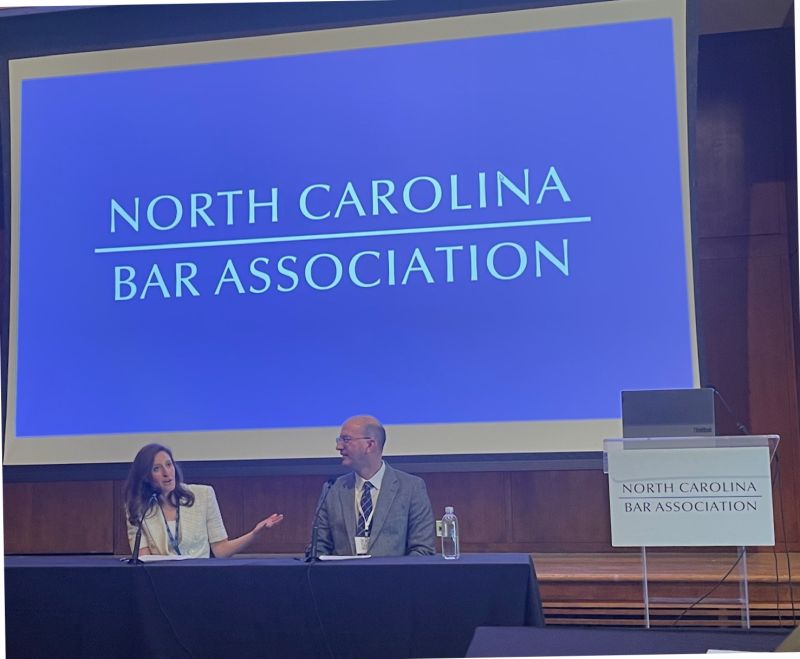
Lauren Gennett and Rob DeConti speaking at the NCBA Health Law Section 2026 Annual CLE in April 2026.
Did you know any health law attorneys before deciding on this practice area?
In college, I interned at the Center for Adolescent Health & the Law (CAHL) in Carrboro, North Carolina, where I worked with an attorney named Abigail English. CAHL’s mission is to promote the health of adolescents and their access to comprehensive healthcare. Abigal was an incredible mentor for me, and working at CAHL was one of my first tangible experiences where I could see how the law impacted clinical care.
Not being so far removed from being an adolescent myself at the time, I could really relate to a lot of the issues CAHL was working on, and I could understand the personal impact on patients. I was inspired to write my college thesis on specific regulations impacting adolescent confidentiality in healthcare, and my work with Abigal solidified my desire to pursue law and public health in graduate school.
You interned at the National Health Law Program and worked at the Centers for Disease Control and Prevention as a health policy analyst. To what extent was your work at the CDC informative to your current role?
At the CDC, I worked in the National Center for HIV, Viral Hepatitis, STD, and Tuberculosis Prevention. As a policy analyst, I worked on a project that measured the impact of laws allowing certain clinical therapies on the incidence of certain diseases. This role also allowed me to see how laws could have a direct and measurable impact on patient care and patient outcomes. It was also inspiring to work at CDC because my colleagues were so passionate about population health.
My time at CDC was a great building block because it gave me a better understanding of how government agencies worked in practice and how administration priorities could impact healthcare. For my next role, I knew I wanted to work on the provider side. I was very interested in the provider perspective and wanted to better understand the challenges providers were facing.
Joining the King & Spalding healthcare team was really a perfect fit for me because the firm has a deeply experienced healthcare team that advises providers and other organizations across the entire spectrum of legal issues impacting the healthcare industry.
You recently co-led a presentation for the NCBA Health Law Section’s annual CLE program. Could you share more about your presentation and why this topic is especially important right now?
I was honored to present with my colleague, Rob DeConti, who has many years of government experience, including most recently serving as the Chief Counsel to United States Department of Health and Human Services Office of the Inspector General. Rob has a wealth of knowledge from his time in the government, and I have been fortunate to work closely with him at King & Spalding.
The focus of our NCBA Health Law Section CLE program was government enforcement and compliance developments. At King & Spalding, both Rob and I focus our practices on defending healthcare providers and other healthcare organizations in government enforcement actions, including False Claims Act matters. We also counsel clients on internal investigations and regulatory compliance. In our presentation, we aimed to couple Rob’s invaluable insight from his time in HHS OIG leadership with my many years of defending healthcare organizations. We had a conversation that touched on the enforcement priorities we are seeing right now in the cases we are defending. We were also able to offer insight on how healthcare organizations can deploy their resources to mitigate risk in the ever-evolving and complex healthcare industry.

What did you hope people would take away from this presentation?
Rob and I focused on sharing information about the current enforcement targets we are seeing in the healthcare industry in our practice. At the same time, we also wanted to offer proactive compliance strategies that healthcare organizations can consider to effectively reduce risk, fully recognizing that many organizations are constrained by resource limitations. For example, we discussed how organizations can analyze their own data because we know that the government’s data analytics capabilities have evolved significantly, and because monitoring your own data can be a really effective way to identify potential risk areas for further internal review. Another aspect of our discussion was recommending that organizations consider strategies for addressing risks with the most potential financial exposure, such as compliance with the Anti-Kickback Statute and the Stark Law.
What are some ways that you’ve grown professionally through your service and your involvement with NCBA?
When I moved to North Carolina in 2022, I wanted to find a way to get plugged into the health law community. Little did I know how incredibly welcoming the NCBA Health Law Section would be! Joining the NCBA Health Law Section has given me a forum to get to know a fantastic network of healthcare attorneys across the state. I am thankful to be involved in such a collaborative group that is focused on making connections across the spectrum of health law practice.
For more than 18 years, you’ve served as a board member with MedPLUS Connect, a nonprofit that helps to provide medical supplies to developing countries. What are some of the initiatives you’ve been involved in?
The mission of MedPLUS Connect is to connect recovered and donated medical supplies to underserved health systems in developing countries in a sustainable manner. The origins of MedPLUS Connect date back to my time at UNC. I spent a summer in West Africa and ended up visiting hospitals to shadow providers in a rural area of Ghana. The physicians showed us some of the donated medical supplies they had received from other countries. I will never forget seeing a beautiful new donated centrifuge sitting unopened and wrapped in plastic. And that same day, the hospital had run out of clean gloves. My co-founders and I were inspired by the goodwill and generous intentions of the donors but realized that there was sometimes a disconnect between what the hospital was receiving and what they really needed — gloves, sutures.
That was the day that catalyzed the idea of MedPLUS, an organization that is driven by the needs of the recipient hospitals. MedPLUS collaborates with organizations in the United States such as MedWish that recover medical supplies. There are so many surplus medical supplies that can be redistributed from the United States to medically underserved communities other countries. We worked with recipient hospitals in Ghana to ensure that they received supplies that matched the priorities and needs of each hospital. The other important and unique aspect of MedPLUS is that we try to send supplies in partnership with recipient governments instead of solely relying on grant money, with the goal that our process is sustainable. The cadence of our shipments is driven by a lot of different factors, but even when we do not have a large shipment in the works, we are regularly working on smaller projects to stay connected. One of our board members lives in Ghana, and we have another one who spends about half the year there.

Gennett visited Ghana in 2009. Here, MedPLUS Connect supplies are being unloaded in Ghana.
How has it been meaningful to you to be a part of this nonprofit?
It’s difficult to articulate how moving it has been for me to be at a rural hospital in West Africa and see the nurses, doctors, and community members be overjoyed when a trailer full of medical supplies arrives. It is so rewarding to watch the community come together to unpack supplies and equipment that will be supporting their local healthcare ecosystem. As a young person, it was a great lesson for me because I experienced how truly listening to the needs of others was a pathway to solving problems. Those lessons have stayed with me and ring true in my legal career.
What tensions, if any, are you currently navigating in your practice?
Healthcare organizations are operating in a highly regulated, complex industry that is also experiencing an era of technological change and growth. In my practice, I defend my clients in healthcare enforcement matters, while also advising on proactive strategies to enhance compliance programs in an effort to mitigate potential risk.
You mentioned recent changes in technology. How has AI impacted the healthcare industry?
There are many AI tools with so much promise to enhance the provision of healthcare and reduce administrative burdens. At the same time, it is imperative to ensure there are sufficient controls in place, and patient privacy is secured. Healthcare is such a highly regulated industry, so we see a bit more tension with emerging technology as organizations want to capture benefits but at the same time need to make sure proper controls are in place. There is a balance, but overall, I am very excited to see where this technological growth takes the industry.
What are some of the trends you see on the horizon in health law?
Healthcare is really evergreen in terms of enforcement. There continues to be tremendous growth in the healthcare industry as well as regulatory change. And with all of those changes and advancements naturally comes enhanced regulations and scrutiny. I expect that we will continue to see scrutiny on healthcare organizations in targeted areas that align with administration priorities such as arrangements, emerging technologies, cyber security, quality of care, post-acute care and managed care. I feel honored to be in a position where I can support healthcare providers and other organizations as they are navigating these dynamics and working to provide care for patients.
Jessica Junqueira is communications manager for the North Carolina Bar Association.