

LeAnn Nease Brown: The Quintessential Renaissance Lawyer

LeAnn Nease Brown, who served as president of the North Carolina Bar Association and the North Carolina Bar Foundation in 2019-20, is no stranger to our members. A snapshot of her bio reveals leadership of numerous sections and committees, multiple awards, and a distinguished legal career. She holds three degrees from the University of North Carolina at Chapel Hill – bachelor’s degree in psychology and history, master’s degree in rehabilitation counseling from the School of Medical Allied Health Sciences, juris doctor from the UNC School of Law – and practices law in Chapel Hill with her husband and law partner, Gordon Brown, at Brown & Bunch, PLLC.
LeAnn also has many outside interests, including tennis, music, theater, movies, and dancing – competitive ballroom dancing (DanceSport). For these and many other reasons, she received the H. Brent McKnight Renaissance Lawyer Award at the NCBA Annual Meeting in June. The award, first presented in 2006, honors the late U.S. District Judge for the Western District of N.C., who was by all accounts a Renaissance lawyer of the highest order. At the time of his death in 2004, Judge McKnight was chairing the NCBA Professionalism Committee. Former Chair Erna Womble and her husband, Bill Womble Jr., were instrumental in the Professionalism Committee’s effort to establish this award.
The connections between LeAnn and Erna and Bill run deeper. At the request of LeAnn, who was president-elect at the time, Erna agreed to serve as founding chair of the Professional Vitality Committee (PVC), on which Bill also serves. And, connecting one final set of dots, Bill and Erna nominated LeAnn to receive the 2021 H. Brent McKnight Renaissance Lawyer Award, about which she provided these insights:
What does it mean to be a Renaissance lawyer?
A phrase I shared with Erna Womble when discussing PVC reflects what I believe is our collective goal: living while lawyering. It is very important as professionals to lawyer well and to have a vibrant life. The goal of the Professional Vitality Committee is what this award is about: helping members find a way to be all they can be professionally and personally, never losing sight of the things that motivate and bring personal joy.
Coming out of law school, three years have been devoted to learning to think a different way. We are trained to think as lawyers, and we have decades to develop as lawyers. Sometimes it is difficult to keep the essence of the other parts of our lives. What it means to be a Renaissance lawyer – what Judge McKnight embodied – was a gusto for life that included being a lawyer but wasn’t limited to that. That’s what this award means to me, embracing the journey, and finding a way to bring balance and purpose to our personal and professional life. Through the process of developing a career and raising a family, some things get set aside. It is important to rediscover those things.
Among your many interests, how is it you stayed involved with tennis before, during and after raising your children?
I played a little tennis and encouraged my children to play when they were small to have someone to play with. Both of my children played USTA tennis in North Carolina, and my youngest played for Wofford College before he decided to focus more on the academic side of his college career.
We travelled to tennis tournaments in and out of state, and I got involved in USTA North Carolina as a parent representative on committees. That participation evolved and I now serve on the management committee of USTA North Carolina. I work with the tennis community on the business side and play a lousy game of tennis on the personal side.
My oldest child was in the high school band and jazz band, and played in the jazz band in college, so I was a band chaperone and pit crew while he was in high school. I would go on Friday nights after work and carry equipment out on the field at halftime. So, while the children were younger, my life balance was child-based, but I enjoyed every minute of it.
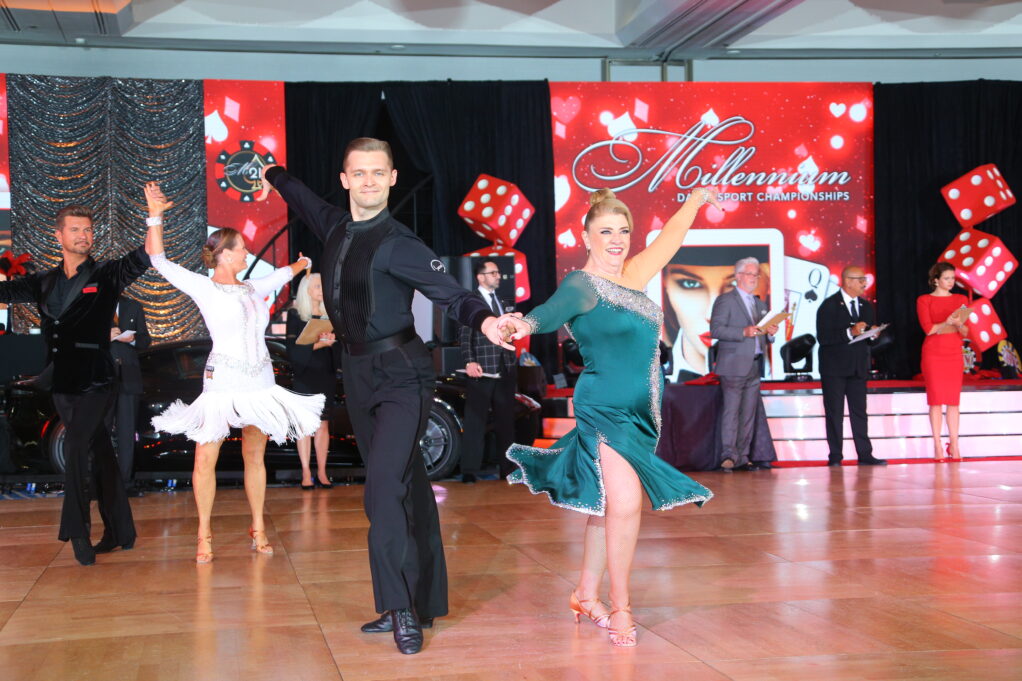
It’s no secret that you have a passion for dancing in general, and ballroom dancing in particular. How did that come about?
The ballroom dance journey is interesting. When I was a child, I took ballet and tap like countless little children do, a half hour once a week. I did that through my childhood and added jazz class when I was 12. I was fortunate my high school, Dudley High School, had something that none of the other Greensboro high schools had – a dance group. Our gym teacher had been a professional dancer in New York, so I got to be a part of the Dudley High School Dancers. I danced through college. I performed in one small amateur theater piece with the ArtsCenter and then went to law school.
While in law school, a lot of stuff needs to be put on a shelf. With my dancing, it was shelved a long while. About five-and-one-half years ago Gordon gave me a gift certificate for dance lessons so we could dance better on a trip we were taking. I had done no ballroom dancing, other that standing on my daddy’s feet to waltz when I was three years old. I fell in love with ballroom. Dancing is a part of me. Once I returned to the dance studio, nobody has been able to pry me out.
Have you always had a love for music?
I’ve always had a love for music, and I’ve always had a love for dance. I love live theater. Gordon and I are so looking forward to going back. We hold season tickets at DPAC and North Carolina Theater, and frequent PlayMakers. There are a lot of Playbills lying around our house. We love it. And we love movies. Gordon and I have an Oscar tradition – every year, we try to see every nominated movie at least through the screenplay awards.
Has this always been a passion of yours?
Yes. When I was little, and before my mother got sick, my parents would dress up and go out on Friday nights and dance at a Supper Club. Sometimes they would have kid nights and I would get to go, too. That was special. Apparently, I was a ham then, too. This was before karaoke, but one family night the band conductor asked for people to come up and sing. I was probably three or four years old. I jumped up from the table and ran up on the stage and told them I would sing “Fascination.” The band played but I just stood there. The bandleader finally said, “Honey, what’s wrong?” And I said, into the microphone, “my mouth won’t work,” and went back to my seat. My performance debut was lacking.
I did something similar when my family was on a cruise. At the Captain’s Ball, the Captain asked for a lady to come dance the first dance with him. And my mother turned around and I was GONE. Guess who volunteered to dance with the Captain? I was three years old – so I guess I’ve always loved “participatory performance art.”
As has been evident at the NCBA Annual Meetings, I’m always ready to dance. One day while President-Elect, I argued in the Court of Appeals in the morning, came by the Bar Center for a meeting, went from the Bar Center to the airport, got on a plane and competed in Atlanta the next day. If you play music, I am ready to dance.
Speaking of The Renaissance, do you think we might experience something of the sort as we transition out of the pandemic?
It will be interesting to see. Some people are coming out of the pandemic saying, “You never know when your last chance is going to be, so I am going to get out into the world.” Other people have enjoyed aspects of a more home-focused life. I think we will see a mixed response.
People are trying to figure out how they feel about going to work, how they feel about their jobs, and we will see societal shifts. The pandemic created an opportunity for people to self-evaluate. There were more quiet moments to reflect upon and identify what you enjoy doing and not doing.
The pandemic also created an opportunity for people to pursue their passions despite restrictions and social distancing.
I’ve been dancing throughout … I danced virtually. I took lessons in my kitchen, which was kind of weird, but it turned out to be a positive thing. I was back in person as soon as possible. I also helped USTA North Carolina try to figure out best advice to allow tennis to be played. We created a task force to figure out how to play more safely. People found a way during the pandemic. We’ve seen very creative solutions for work and for play.
An example is a virtual opera production in which Erna and Bill’s daughter stars. She is a talented opera singer. Unable to perform together, her opera company, virtually, in different places, performed, “The Magic Flute.” It is amazing to see. It’s a fabulous production and a good example of people figuring out a way to keep their passion alive.
What is it about the art of dancing you find so interesting?
 The variety of dance, for example, dancing syllabus in competition differs from showcase dance and those are very different from social dancing. Showcase work is a form of acting. The process begins by choosing a piece of music that speaks to you, having it choreographed and learning the steps.
Once you learn the choreography, you try to get to the place you can perform it. Dancing steps and performing are different. Performance means using dance to define the characters and tell the story. Good performance – good show dance – tells a story in the two minutes of the show.
Syllabus dance is different. Musicality and connection with your partner are key parts but so is technique. Nonetheless, you are more successful – when you’ve stopped focusing on the fact somebody is judging your dancing and dance with joy. Every part of you needs to be performing as best you can, and every time you are on the floor it must be the best you can do. It can’t always be the best, but that’s your goal. You’re giving it everything you’ve got without putting so much energy into one heat you cannot do the next dance. It’s an interesting balance. It’s about taking something you’ve been working hard on and making it as perfect as you can make it.
Learning to dance brings its own joy. I work hard on the small things that make the dance look right, and I enjoy that process too. I enjoy learning technique and the elements that make one person look better than another doing the same steps. What are all the little things they’re doing differently? It is a long and probably endless process. But that’s what it’s about, the journey.
Another thing about ballroom that’s rewarding is the partnership aspect. In that way it is like playing doubles in tennis. You not only learn what you must do, you coordinate with another human. The two of you must be in the same rhythm and on the same page. I think that’s an interesting aspect of both sports. It’s really a process of cooperatively making each other look good and giving each other the space to make it happen. It’s sharing energy. Watching professional dancers compete is fascinating. The dance is so beautiful and good dancers make it look so easy but it’s not. There’s nothing about it that’s simple. It becomes an amazing expression through hard work and passion. Dance performance is like making sandcastles; your art is there and then it’s gone. If you do the same thing 45 times, it will look slightly different each time. Another part of it is dealing with missteps. All this a part of the art.
Does this same approach translate into the practice of law?
It does. Lawyers do many things, but the concept that you work hard to understand something, to perfect your work and to share it with somebody so it resonates with them is lawyering. And the art of working collaboratively with others to achieve a result is part of what we do as lawyers.
For example, completing a transaction or mediation or negotiation is a dance – the parties may not start out in quite the same direction or be doing the same thing, but they’re trying to figure out how to make it happen.
What about the competitive aspects of lawyering vs. the competitive aspects of dance?
 In a ballroom studio, there are people learning to dance for many purposes. Some want to social dance. Gordon takes lessons, so we can dance in a social setting and have a good time. Some dancers are preparing for upcoming events, like weddings. Some want exercise. Some want an activity with a spouse or significant other. Many people have no need to perform in front of other people and for some people, doing so is not remotely desirable. And then there are those who enjoy performance very much and those who want to go out and see how they compare. Some people like to compete, and some don’t. I can use the same analogy in tennis – there are people who want to play socially and there are people who want to play competitive matches. The idea is to determine what part of it fits you, what brings you joy. And the same is true in the law. People have different interests and different comfort levels. Our goal is to find out where we thrive in the profession, where we are comfortable making a difference.
The stories about being a ham when I was little show my willingness to go out in front from an early age. I get nervous like everybody does and sometimes my mouth won’t work and “Fascination” is not sung but whether it is lawyering or dancing, I am willing to take the stage.
People have different comfort levels, and going back to being a Renaissance lawyer, it means you find where you enjoy life and put yourself in that place. The key to being a good lawyer and being comfortable being a lawyer is finding both work and play that fits what you’re about . . . that matches you. Where are you comfortable putting your energy? What will fulfill you? What will bring you joy?
Closing thoughts?
One meaning of “renaissance” is revival and renewed interest. Giving yourself permission to be you is key to both. No one succeeds trying to be somebody they are not. You’re not going to succeed, you’re not going to be fulfilled, and you will probably be miserable. What somebody else thinks you ought to be doing, or where somebody else wants to pigeon-hole you is not what defines you. One of the most important things we do is figure out how to be ourselves. Unfortunately, we often glimpse ourselves in the rearview mirror. What I wish for each of us is the ability to be bold in being ourselves as lawyers, as artists, as musicians, as athletes, as book lovers, as bird watchers, as anything that touches us. It is by doing so we are revived and renewed.
Dance photos from the Millennium Dancesport Championships are provided by Ryan Kenner Photography.
Russell Rawlings is director of external affairs and communications for the North Carolina Bar Association.